1. The Basic Principles of Wealth Building
Keeping Personal Finance Simple
When people start thinking about building wealth, many find themselves wondering which financial products they should choose. Today, there are many different financial products available, and this can feel overwhelming for beginners.
On this point, financial commentator Hajime Yamazaki argues that personal finance should be kept as simple as possible.
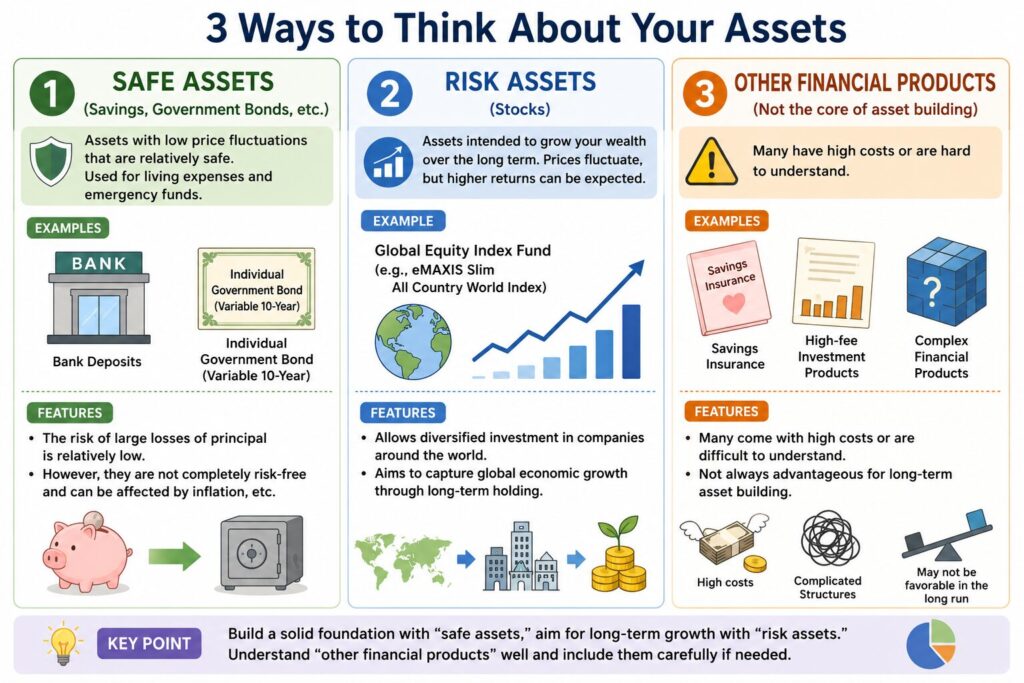
If we organize this idea, financial products can broadly be divided into three categories.
The Three Types of Assets
① Safe Assets (Cash Deposits, Government Bonds, etc.)
- Assets with relatively small price fluctuations
- Used for living expenses and emergency funds
Examples:
- Bank deposits
- Individual government bonds (10-year floating rate)
Characteristics:
- Low risk of large principal loss
- However, they are not completely risk-free and may be affected by inflation
② Risk Assets (Stocks)
- Assets intended for long-term wealth growth
- Prices fluctuate, but higher returns are expected over time
Typical example:
- Global equity index funds
(e.g., eMAXIS Slim All Country)
Characteristics:
- Broad diversification across global companies
- Aimed at capturing long-term economic growth
③ Other Financial Products (Not for Core Asset Building)
Examples:
- Savings-type insurance products
- High-fee investment products
- Complex financial products that are difficult to understand
Characteristics:
- Often high-cost or difficult to understand
- Not necessarily suitable as core tools for long-term investing
What You Should Do First
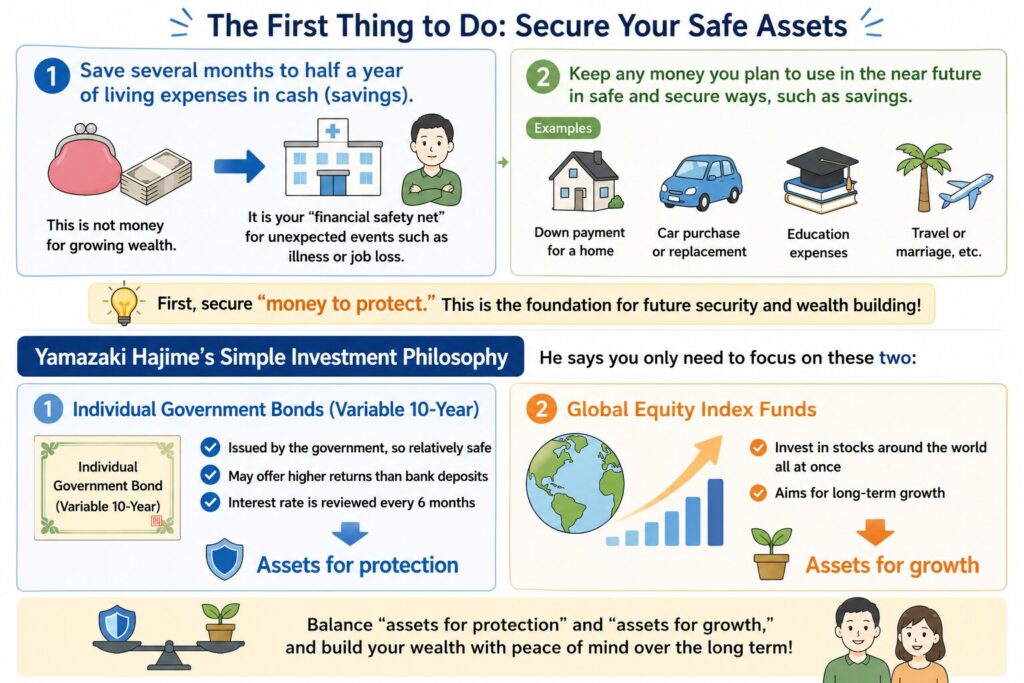
The first important step in building assets is to secure a solid base of safe assets.
Specifically:
- Keep 3 to 6 months of living expenses in cash savings
This is not money intended for investment growth, but rather an “emergency buffer” to prepare for unexpected events such as illness or job loss.
In addition, money that you plan to use in the near future should also be managed in safe, liquid forms such as cash deposits.
Who This Series Is For
This “How to Save Money” series is intended for:
- Those who have already secured emergency savings
- Those who want to build assets separately from daily living funds
A Simple Investment Philosophy by Hajime Yamazaki
Yamazaki argues that personal investing can be simplified into just two core instruments:
① Individual Government Bonds (10-year floating rate)
- Issued by the government, making them relatively safe
- May offer better returns than bank deposits
- Interest rates are revised every six months
→ Assets for protection
② Global Equity Index Funds
- Invest in stocks around the world in a single fund
- Designed for long-term growth
→ Assets for growth
Conclusion
Personal finance does not need to be complicated.
It can be understood through two core ideas:
- Safe assets (money to protect)
- Risk assets (money to grow)
By combining cash deposits, government bonds, and index funds according to your goals, it is possible to build a sustainable and realistic investment strategy.
The most important point is not to chase complicated financial products, but to stick with a system you understand and can continue over the long term.
Future Topics in This Series
This series will cover the following topics step by step:
- Basic tools for managing personal finances
- How to build a “personal pension” using government bonds
- How much risk assets you should hold
- Why global equity index funds are a strong investment choice