
When You Can No Longer Make Your Own Decisions Part 1. Understanding the Difference Between Trusts and Guardianship
“Trusts” and “guardianship” are both systems related to asset management, so they are often confused with one another.
In fact, many people ask questions such as:
- “Aren’t they both systems for managing assets?”
- “What’s the difference?”
- “If I set up a family trust, do I no longer need guardianship?”
In this article, rather than providing a strict legal explanation, I would like to explain the concepts in a way that makes the differences easier to visualize and understand.
Please note that the following explanation is intended as a simplified illustration for understanding purposes, so it may not be legally precise in every respect.
Let’s Start with the Example of a Child
Imagine that a small child saves some allowance money and deposits part of it in a bank.
In this example:
- The relationship between the child and the parent = guardianship
- The relationship between the child and the bank = trust
Thinking of it this way makes the difference between the two systems easier to understand.
Of course, the actual legal systems are not exactly the same as this example, but it is a useful way to understand the difference in their roles.
Guardianship: A System for Making Decisions and Handling Procedures on Someone’s Behalf
A small child cannot make sufficient decisions independently.
Therefore, in situations such as:
- Signing contracts
- Making purchases
- Being admitted to a hospital
the parent makes decisions on the child’s behalf.
Adult guardianship works in a similar way.
When a person’s decision-making ability declines due to dementia or another condition, a guardian handles necessary decisions and contracts for that person.
In other words, a guardian is not simply “someone who manages money.”
In addition to managing the person’s assets, the guardian may also handle matters such as:
- Hospital admission procedures
- Contracts for nursing home or care facility placement
- Various contracts and cancellations
In these situations, the guardian performs necessary legal acts for a person who can no longer make decisions independently.
It may therefore be easiest to think of guardianship as “a system for handling daily-life decisions and procedures on someone’s behalf.”
Trusts: A System for Managing Assets Only
A trust, on the other hand, is a system for managing entrusted assets.
Returning to our earlier example, when a child deposits money in a bank, the bank manages that money.
However, the bank does not:
- Handle the child’s hospital admission procedures
- Sign contracts on the child’s behalf
- Make decisions about the child’s daily life
Those responsibilities belong to the parent — in other words, the role similar to guardianship.
Trusts work the same way. Their role is limited to managing the entrusted assets.
Accordingly, under the terms of the trust agreement, the trustee may:
- Manage investments
- Manage real estate
- Make payments
However, the trustee cannot go beyond that and:
- Arrange hospital admissions
- Sign facility admission contracts
- Make everyday life decisions on behalf of the person
In other words, a trust is “a system for managing assets,” not a system for making daily-life decisions and handling procedures on someone’s behalf.
A “Person-Oriented” System vs. An “Asset-Oriented” System
Put simply:
- Guardianship is a system focused on the person
- Trusts are systems focused on specific assets
Understanding this distinction makes the different roles of the two systems much clearer.
Also, trusts and guardianship are not systems where one is “better” than the other. They simply serve different purposes.
For that reason, depending on the situation, trusts and guardianship may sometimes be used together.
Another Major Difference: Ownership of Assets
There is another important difference between trusts and guardianship.
That difference concerns ownership and title to assets.
In a trust arrangement, legal title to the entrusted assets is transferred to the trustee for management purposes.
Under guardianship, however, ownership of the assets remains with the individual.
This point is very important when designing estate plans or inheritance strategies, but since it becomes somewhat technical, I would like to discuss it in more detail another time.
Conclusion
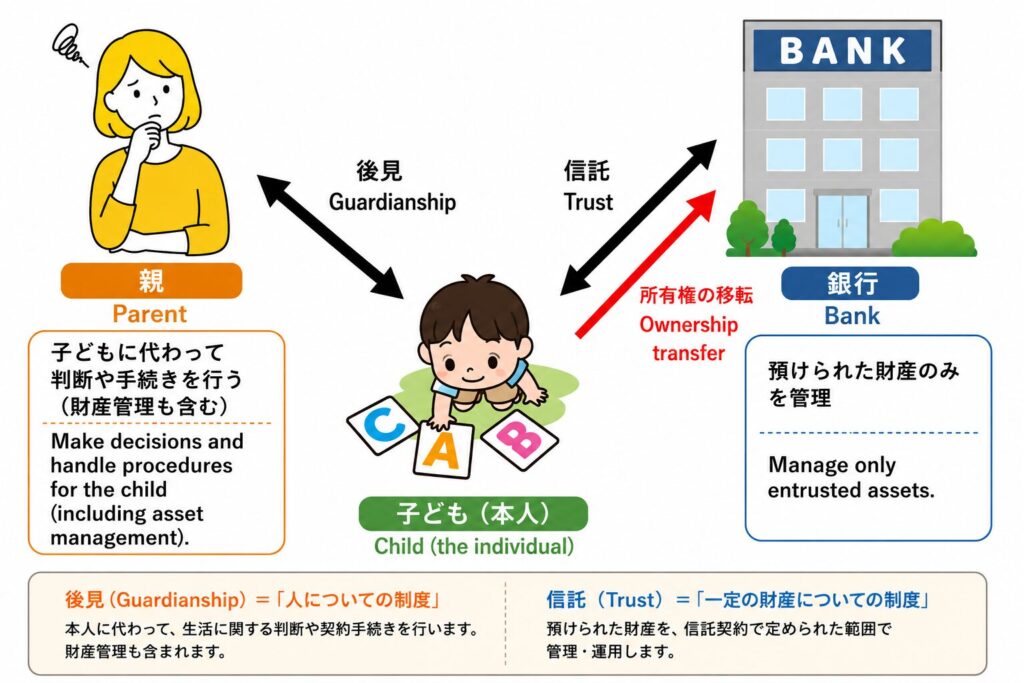
Both trusts and guardianship are systems used to support individuals, but their roles are fundamentally different.
As a simple image:
- Guardianship = the relationship between a parent and child
- Trust = the relationship between a child and a bank
This analogy may help clarify the difference.
- Guardianship is “a system for making decisions and handling procedures on someone’s behalf”
- Trusts are “a system for managing assets only”
Before diving into detailed legal provisions, it may help to first understand this basic image of how the two systems differ.