Criminal Law Classification of Euthanasia
Euthanasia refers to a situation in which a patient suffering from unbearable pain and approaching death chooses death through means that shorten life in order to escape that suffering.
Under Japanese case law, euthanasia is generally understood as being carried out by a physician, and one of the most important issues in classifying euthanasia is the presence or absence of intent to kill.
If intent to kill is recognized, homicide may apply; if such intent is absent, offenses such as negligent homicide may instead become relevant. Because the severity of punishment differs greatly between the two, the existence of intent to kill is an important issue under criminal law.
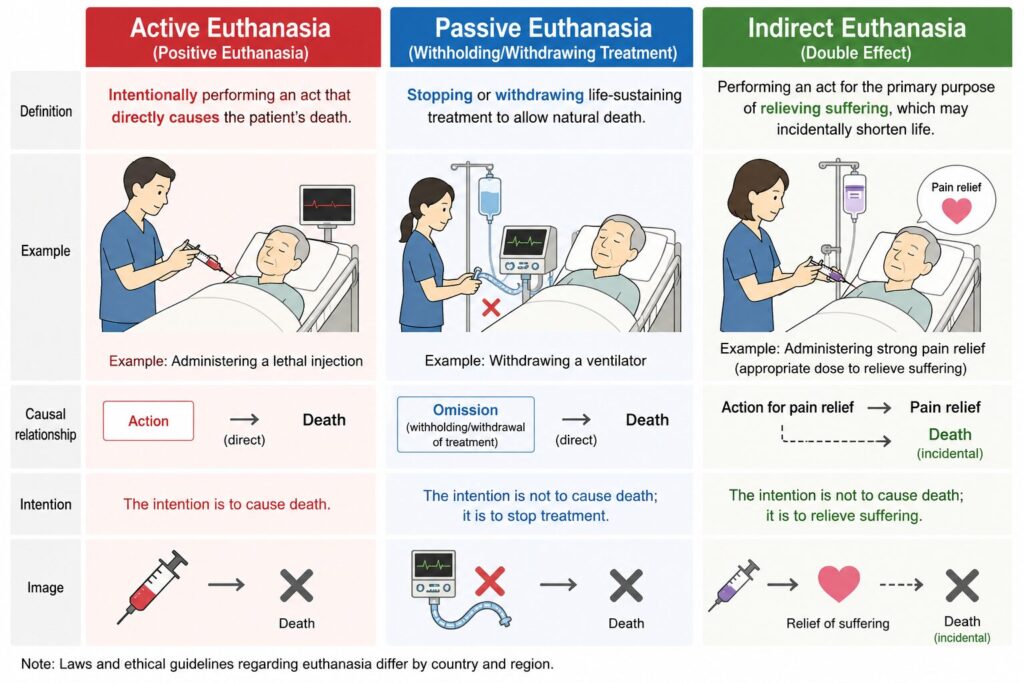
From this perspective, euthanasia can be classified into the following three categories.
1. Cases Involving Intent to Cause Death
① Active Euthanasia (with intent to kill)
This refers to causing the death of a patient through medical acts such as the administration of drugs, with the intention of bringing about death.
② Passive Euthanasia (Death with Dignity) (with intent to kill)
This refers to causing the death of a patient by discontinuing life-sustaining treatment such as a ventilator, with the intention of bringing about death.
2. Cases Where Pain Relief Is the Purpose and Death Occurs as a Result
③ Indirect Euthanasia (without intent to kill)
This refers to situations in which a patient dies as a result of side effects from treatment performed for the purpose of relieving pain.
The defining characteristic of ① and ② is that the purpose is to bring about death in order to free the patient from suffering, and the acts are carried out with intent to kill.
By contrast, in ③, the purpose is pain relief rather than death itself, and there is no active intent to kill at the time of the act.
In other words, the greatest difference between ①② and ③ lies in whether there was intent to cause death.
However, even in the case of ③, if treatment is administered while recognizing the risk of death, conditional intent (dolus eventualis) may be found, potentially leading to an evaluation similar to ①.
④ Refusal of Treatment by the Patient
(Choosing not to receive treatment itself)
In a broader sense, euthanasia may also be divided into four categories by including this type.
However, many scholars and legal interpretations do not include ④ within euthanasia.
Overview of Each Category
① Active Euthanasia
This refers to acts that intentionally cause the death of a patient through means such as drug administration for the purpose of eliminating suffering.
The important point is that the medical act is performed with the intention of causing death.
In Japan, such acts may become the subject of criminal prosecution.
In actual court cases, suspended sentences with guilty verdicts are common, and at present no acquittal cases could be found.
Although suicide itself is not punishable under Japanese law, a third party’s involvement in another person’s death may constitute the offense of assisting or inducing suicide.
② Passive Euthanasia (Death with Dignity)
This refers to stopping life-sustaining treatment, thereby hastening death.
Here as well, the key issue is whether there was intent to bring about death.
If a causal relationship between the discontinuation of treatment and the patient’s death is recognized, criminal liability may arise. However, in practice, proving causation is often difficult, and many cases end without prosecution.
③ Indirect Euthanasia
This refers to cases in which a patient dies due to side effects resulting from treatment intended for pain relief or palliative care.
The difference from ① is that causing death is not the purpose.
In other words, the primary purpose is pain relief, and there is no active intent to kill.
However, if treatment is administered while recognizing that “death may occur and cannot be helped,” conditional intent may be recognized, raising criminal responsibility similar to that in ①.
Another difference between ② and ①③ is that:
- ①③ involve death resulting from some affirmative act
- ② involves death resulting from omission, namely the discontinuation of treatment
In this sense, the following ④ may also be considered close to an omission-type case.
In Japan, moreover,
- discontinuing treatment that has already begun, and
- not initiating treatment in the first place
tend to be treated as separate issues both in criminal law and in practice.
④ Refusal of Treatment by the Patient
This refers to cases in which the patient does not wish to receive treatment from the outset, and the physician refrains from treatment in accordance with the patient’s wishes, resulting in the patient’s death.
At present, there are very few cases in Japan in which this has actively been treated as a criminal matter.
Generally, a prior expression of one’s wishes regarding future medical treatment is called a “living will.”
Although this is often confused with passive euthanasia, the Japanese understanding of a living will is essentially a prior choice regarding whether or not to receive treatment.
Accordingly, ④ is characterized by the fact that treatment is not initiated, and is therefore distinguished from ②, where already-begun treatment is discontinued. However, some interpretations include both within the concept of a living will.
Whether refusal of treatment should be included within euthanasia remains a matter of debate.
Organization Under Current Japanese Law
To summarize, under the current Japanese legal framework, euthanasia can generally be classified into the following three categories:
- Intentionally causing death through medical acts
→ Active euthanasia - Intentionally causing death through discontinuation of treatment
→ Passive euthanasia (death with dignity) - Death resulting from side effects of treatment intended for pain relief
→ Indirect euthanasia
In addition, depending on one’s interpretation, the following may also be included:
- Refusal of treatment based on the patient’s own wishes
→ Refusal of treatment (living will)
Among these, categories 1–3 may potentially become criminal cases.
For this reason, in Japan, living wills are generally understood primarily as expressions of intent regarding whether or not to receive treatment.
What a Living Will Can and Cannot Do
In Japan, a living will can generally be used to express whether a person wishes to begin certain medical treatments.
However, the following are still difficult to gain acceptance:
- discontinuing treatment after it has already begun
- requesting actions intended to actively cause death
For example:
“I do not wish to receive treatment using a ventilator.”
→ The patient can express such wishes, and there is a high likelihood that those wishes will be followed.
On the other hand:
“If there is no recovery after 10 days of treatment, remove the ventilator.”
→ Such wishes can also be expressed; however, the actual withdrawal of treatment requires careful medical and ethical judgment, and the patient’s wishes may not always be carried out as requested.
Therefore, expressing one’s wishes before treatment begins becomes extremely important.
Judicial Perspective
In Japan, the Supreme Court has not established clear comprehensive standards regarding euthanasia.
However,
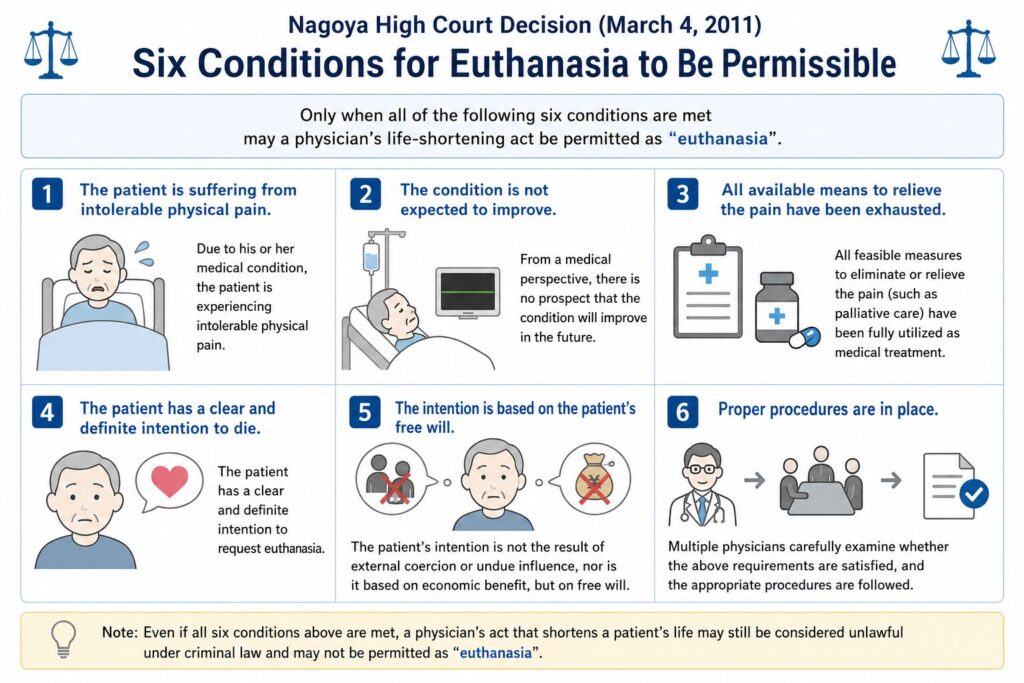
- the “Six Requirements for Euthanasia” established by the Nagoya High Court
- the “Four Requirements for Physician-Assisted Euthanasia” established in the Tokai University Hospital case by the Yokohama District Court
are often referred to as important standards.
In particular, the Tokai University Hospital case is considered significant because the court examined:
- Indirect euthanasia
- Passive euthanasia
- Active euthanasia
in a step-by-step manner and provided detailed judicial reasoning regarding each category.
However, it should be noted that these judicial standards were presented on the assumption that euthanasia might hypothetically be permissible, and they did not legalize euthanasia itself.