
Living Will (2): Nutritional Support
Last time, we discussed cardiopulmonary resuscitation (CPR).
This time, we would like to talk about nutritional support.
Unlike CPR, nutritional support is usually not an immediate life-or-death emergency, since going without food for a few days does not necessarily place a person in immediate danger.
However, due to illness, aging, or various other reasons, some people may gradually become unable to eat enough by mouth.
In such situations, an important question arises:
How should nutrition and fluids be provided?
Common options include:
- allowing the natural course to proceed
- peripheral intravenous fluids
- central venous nutrition
- tube feeding
In this article, we will briefly explain each of these methods.
1. Allowing the Natural Course
This approach means not providing aggressive nutritional support and allowing the condition to follow its natural course.
In this situation, dehydration and malnutrition may gradually progress and eventually affect life expectancy.
On the other hand, some people choose this option because they prioritize the patient’s values and comfort.
Depending on the medical institution or care facility, however, this approach may sometimes be difficult to accommodate because of treatment policies.
2. Peripheral Intravenous Fluids
This method involves inserting a needle into a vein near the surface of the hand or foot to provide fluids and nutrients.
It is similar to the standard IV drip commonly used in hospitals.
However, small peripheral veins can be damaged if highly concentrated nutrition is administered for a long time.
As a result, it is difficult to provide sufficient calories through this method alone, making it less suitable for long-term nutritional management.
In addition, when nutritional status worsens, the body’s ability to keep fluid inside blood vessels decreases, which may lead to noticeable swelling (edema).
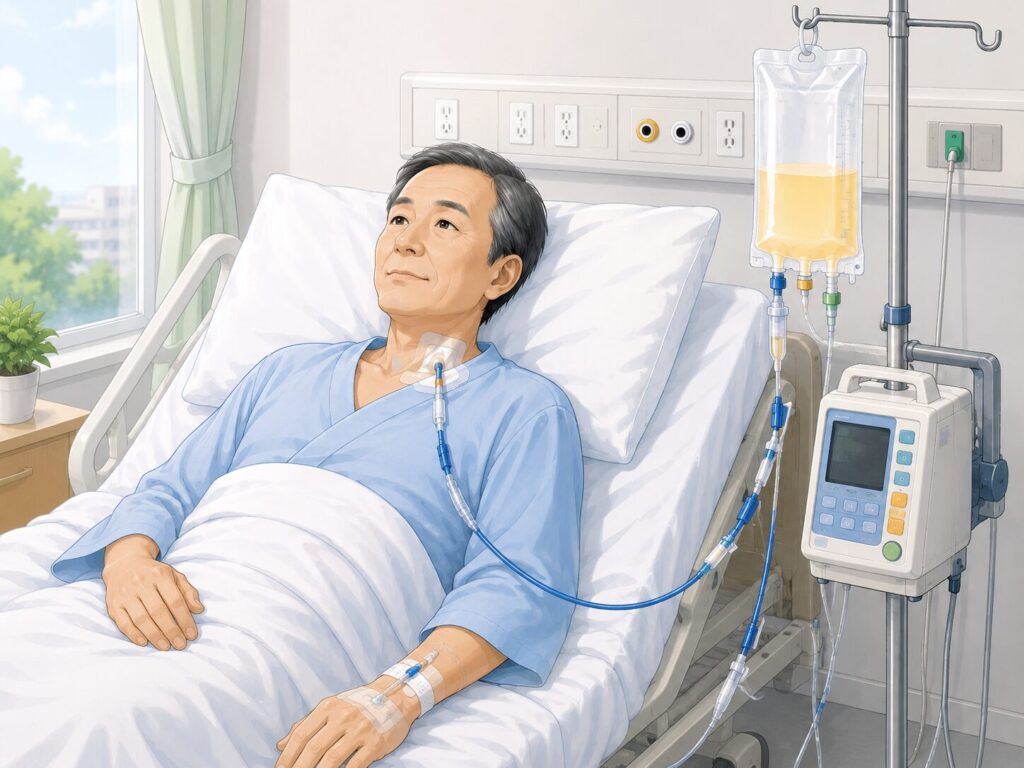
3. Central Venous Nutrition
A central vein is a large vein located near the heart.
Because blood flow is abundant in these veins, highly concentrated nutrition can be rapidly diluted after infusion.
This principle is used in central venous nutrition.
A catheter is usually inserted through a vein in the neck, groin, or arm and advanced to a position near the heart.
This method allows the administration of high-calorie nutrition that would be difficult to provide through peripheral IV fluids, making long-term nutritional support possible.
However, there are also potential problems, such as:
- accidental injury to blood vessels or surrounding tissues during catheter insertion
- bacterial infection related to the catheter
- decreased gastrointestinal function after prolonged use
4. Tube Feeding
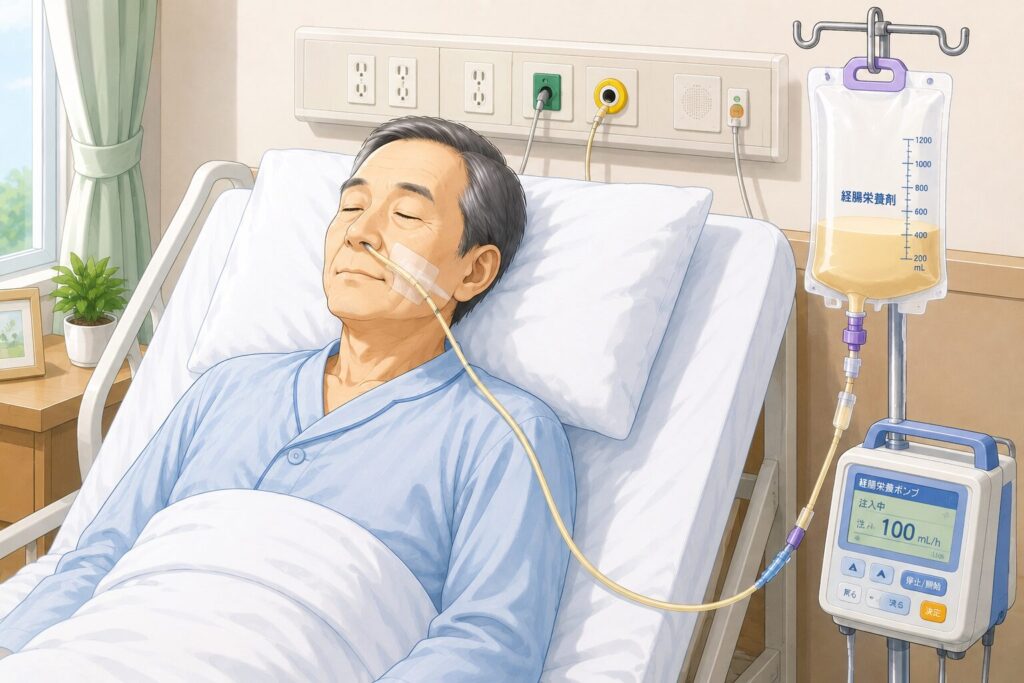
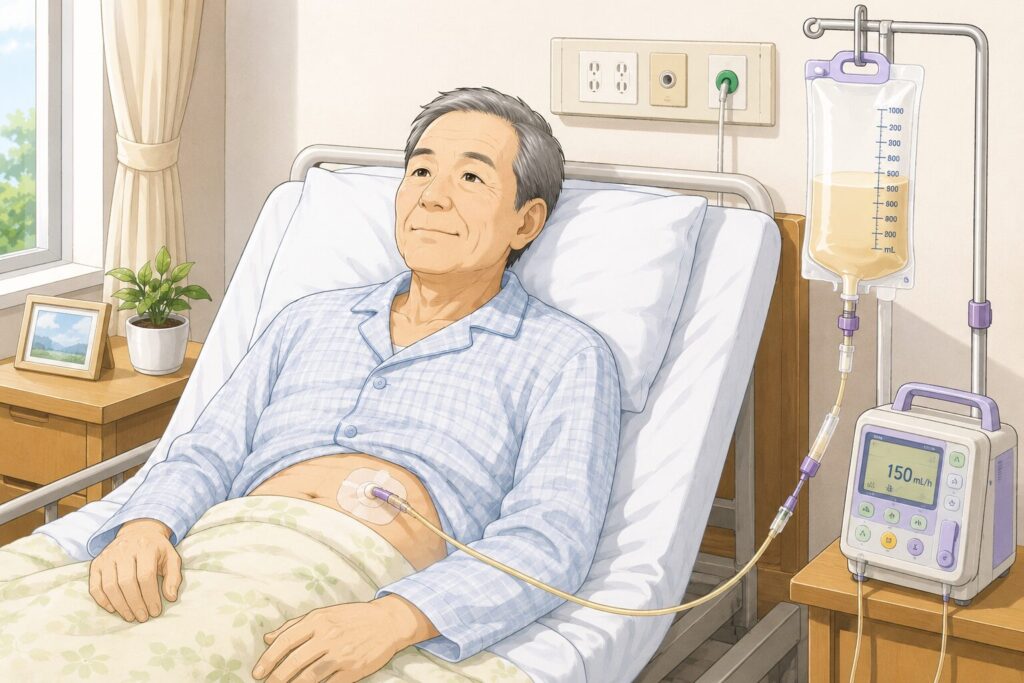
Tube feeding is a method in which a tube is placed into the stomach and liquid nutrition is administered through the tube.
Two common methods are:
・Nasogastric Tube Feeding
A thin tube is inserted through the nose and passed through:
nose → throat → esophagus → stomach
The tip of the tube is then positioned inside the stomach to deliver nutrition.
This method is relatively simple, but the tube may cause discomfort in the nose or throat.
・Gastrostomy Feeding (PEG)
In this method, a small opening is created through the abdomen into the stomach, and a feeding tube is inserted directly into the stomach.
Because the tube does not pass through the nose or throat, some patients experience less discomfort compared with nasogastric feeding.
Another advantage is that tube replacement is usually needed less frequently.
However, creating a gastrostomy requires a medical procedure using an endoscope or similar equipment.
Thinking About Nutritional Support
Advances in medicine now make it possible to provide nutrition and fluids in many ways, even when eating by mouth becomes difficult.
However, each method involves not only benefits, but also physical burdens and risks of complications.
In addition, the most appropriate choice may differ depending on:
- how much treatment the patient wishes to receive
- how the patient values quality of life
When patients are fully conscious and able to express their wishes clearly, treatment decisions can be made together with healthcare professionals and family members.
However, there are situations in which there is little time to discuss these matters.
For that reason, it may be worthwhile to think in advance about:
“What kind of nutritional support would I want?”