
When You Can No Longer Make Your Own Decisions Part 4. Adult Guardianship as Preparation for Dementia
— Voluntary Guardianship, Statutory Guardianship, and How They Differ from Trusts —
In the previous article, we discussed ways to prepare for a decline in decision-making capacity due to dementia or other conditions by entrusting the management of one’s assets to others through bank agency arrangements, civil (family) trusts, and commercial trusts.
These arrangements are mainly intended to address the question of how to manage a person’s assets. However, as dementia progresses, the challenges go beyond asset management. There may be situations in which the person can no longer carry out legal acts on their own, such as completing bank procedures, selling real estate, or entering into various contracts.
In such situations, the adult guardianship system allows someone to act on behalf of the person and handle various procedures. Broadly speaking, there are two types of adult guardianship:
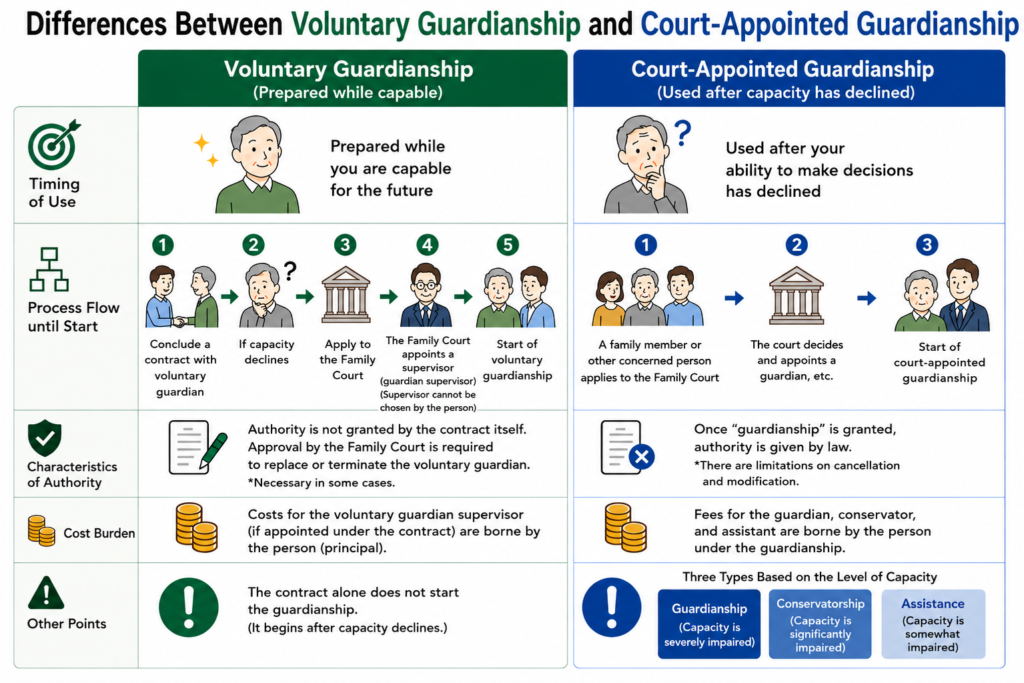
Voluntary guardianship: A system in which a person chooses their own guardian while they still have sufficient decision-making capacity
Statutory guardianship: A system in which the family court appoints a guardian after the person’s decision-making capacity has declined
Let’s take a closer look at the characteristics and differences between these two systems.
1. “Voluntary Guardianship” — Preparing While You Are Still Capable
Voluntary guardianship is a system in which a person decides in advance, while they still have sufficient decision-making capacity, “I want this person to take care of my affairs if I can no longer make decisions for myself in the future.”
While they still have sufficient capacity, they enter into a voluntary guardianship agreement with the person they wish to entrust with their affairs in the future, such as a family member, a trusted third party, or a professional.
How Voluntary Guardianship Begins
Simply entering into a voluntary guardianship agreement does not mean that the system starts immediately. The following steps are required:
- Enter into an agreement with the person who will become the voluntary guardian.
- The person’s decision-making capacity declines.
- An application is filed with the family court.
- The court appoints a supervisor of the voluntary guardian.
- Voluntary guardianship begins.
One important point is that the supervisor of the voluntary guardian is appointed by the court; the person themselves cannot choose the supervisor. In addition, ongoing fees are required for the supervisor.
Points to Keep in Mind
- The system does not begin immediately after the agreement is signed. It starts only after the person’s decision-making capacity has declined and the necessary procedures have been completed.
- A voluntary guardian does not have the same right of cancellation as a statutory guardian—the right to cancel certain contracts or legal acts carried out by the person. If the person’s capacity declines to the point where such a right becomes necessary, statutory guardianship may need to be considered.
2. “Statutory Guardianship” — Used After Decision-Making Capacity Has Declined
Statutory guardianship is used when dementia progresses without prior arrangements and the person can no longer adequately understand the terms of a contract, or when their decision-making capacity has declined to the point that a voluntary guardian can no longer adequately manage their affairs.
The person themselves, their spouse, or certain relatives can apply to the family court, and the person receives support according to the degree of their decision-making capacity.
Statutory guardianship is divided into three levels:
Guardianship: Decision-making capacity is lacking
Curatorship: Decision-making capacity is significantly impaired
Assistance: Decision-making capacity is impaired
When a person is placed under the most comprehensive level, Guardianship, the statutory guardian is given the right to cancel certain legal acts carried out by the person. This is one of the major features of statutory guardianship that is not available under voluntary guardianship.
Fees for guardians, curators, and assistants are incurred.
You Can Use the System Even If You Have No Family
The adult guardianship system is not limited to people who have family members.
If it is difficult for relatives to file an application and the local government determines that an application is necessary for the person’s welfare, the mayor of the municipality can also file the application.
As the number of elderly people living alone increases, the system also plays an important role in supporting people’s lives and assets as a society.
Family Members Can Also Become Guardians
It is often assumed that “a professional such as a lawyer becomes the adult guardian.” In reality, when a family member is proposed as a candidate for guardian, there are also data showing that the family member is appointed in approximately 85% of such cases, although this is not official court statistics.
One of the main reasons that professionals account for a large proportion of guardians overall is that applications proposing family members as candidates are relatively uncommon.
If you want a family member to serve as the guardian, you can nominate that person as a candidate when filing the application. However, the final decision is made by the family court, so there is no guarantee that the family member will be appointed.
3. How Are Trusts Different from Adult Guardianship?
Both trusts and the adult guardianship system can be used to prepare for asset management in the event of dementia, but their roles are clearly different.
Trust: “A mechanism for entrusting assets to someone for management”
Adult guardianship: “A mechanism for representing and protecting the person”
Under a civil (family) trust, assets designated by the person are entrusted to a trustee, who manages them according to the purpose of the trust agreement. This management can continue even after the person develops dementia.
However, the trustee can manage only the assets placed in the trust and cannot act on behalf of the person in all of their legal affairs.
By contrast, under the adult guardianship system, the guardian manages the person’s assets for their benefit and can use their authority to carry out legal acts on the person’s behalf.
4. Rather Than Choosing Between a Trust and Guardianship, Consider Combining Them
When preparing for dementia, people often think in terms of choosing between a trust and guardianship. However, because the two systems have different roles, they are not necessarily mutually exclusive.
- Assets intended for future living expenses or nursing-care expenses can be placed under the management of a family trust.
- Daily legal matters and contracts that cannot be handled through the trust can be handled by a guardian on the person’s behalf.
In this way, it is often useful to combine the strengths of the two systems and divide their respective roles.
Conclusion: Expand Your Options While You Are Still Healthy
As we have seen, there are various ways to prepare for a decline in decision-making capacity due to dementia.
The systems themselves may appear complicated, but the basic idea is simple:
First, think about what you want to entrust to whom if you are no longer able to make decisions for yourself, and then choose the system that best fits your wishes.
Preparing for dementia is not simply about protecting your assets. It is about making sure that your assets can be used for your own life, in the way you want, even if you can no longer manage them yourself.
We encourage you to think about how you want your assets to be managed in the future while you are still healthy and able to make your own decisions.
In the next article, we will look at how to use each of these systems in practice, focusing on the simplest approaches possible.