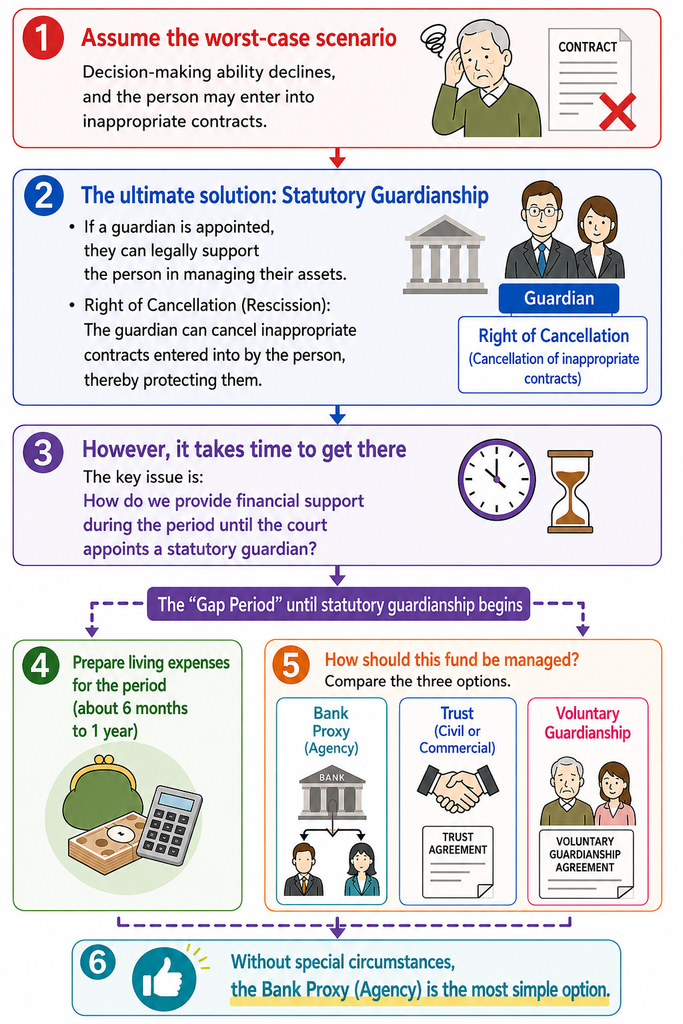
When You Can No Longer Make Your Own Decisions Part 5. Managing Finances in Preparation for Dementia — Which System Should You Choose?
So far, we have discussed bank proxy services, trusts, voluntary guardianship, and statutory guardianship.
After looking at these various systems, you may be wondering, “Which one should I actually use?”
So, in this final part, I would like to consider how these systems can be used differently, by simplifying the issue as much as possible.
First, Consider the Worst-Case Scenario
Let us first consider the worst-case scenario.
As dementia or other conditions cause a decline in decision-making capacity, a person may enter into a disadvantageous contract that they would never have agreed to while they still had full decision-making capacity.
Under the Civil Code, a legal act performed when a person lacks the capacity to understand and make decisions is considered invalid.
However, in practice, in order to have a contract declared invalid, it is necessary to prove that the person lacked the capacity to make the decision at the time the contract was entered into, which is not always easy.
By contrast, when a guardian has been appointed, the person is officially recognized as lacking sufficient decision-making capacity. Therefore, legal acts performed by the person after a statutory guardian has been appointed can, in principle, be cancelled.
In other words, statutory guardianship serves as the ultimate safety net when dementia progresses to the point where a person can no longer adequately manage their own assets.
The Problem Is the Period Before Statutory Guardianship Begins
To use statutory guardianship, an application must be filed with the Family Court, and a guardian must be appointed through a court decision.
It can take several months from the filing of an application until a guardian is appointed.
In other words, once a person’s decision-making capacity has declined, their assets may become inaccessible until a guardian is appointed (for example, their bank account may be frozen).
This creates a problem.
Even while waiting for a guardian to be appointed, the person still needs money for everyday living.
Food, housing, medical care, nursing care, and other expenses must still be paid. We therefore need to consider how to provide the money necessary to maintain the person’s daily life.
Given that the statutory guardianship process can take several months, it is advisable to secure enough funds in advance to cover the person’s living expenses for, for example, six months to one year, and to establish a system that allows those funds to be accessed on the person’s behalf.
If this period can be covered, the person’s financial management can then be transferred to the appointed guardian.
In other words, the minimum preparation is to secure funds equivalent to approximately six months to one year of the person’s living expenses in advance and establish a system that allows those funds to be managed on the person’s behalf.
Based on this, the basic approach to minimum financial preparation for dementia can be summarized as follows.
① Ultimately, connect to statutory guardianship
If decision-making capacity declines to the point where the person can no longer manage their own assets, statutory guardianship can be used.
② Secure funds for the period before statutory guardianship begins
Taking into account the possibility that the court process may take several months, secure enough funds to cover approximately six months to one year of the person’s living expenses.
③ Decide how those funds will be managed
Only at this point should you compare options such as bank proxy services, trusts, and voluntary guardianship.
In other words, you do not necessarily need to prepare all of these systems from the outset as part of your preparation for dementia.
First, consider:
“How can we get through the period before statutory guardianship begins?”
This is the minimum preparation that should be considered.
So, How Should These Funds Be Managed?
Then, what system should be used to manage the living expenses needed until statutory guardianship begins?
1) Bank Proxy Services
(Specialized services such as “designated future proxy” services, rather than ordinary proxy cards, that allow withdrawals even after decision-making capacity has declined)
Advantages: The procedures are relatively simple, and there is little or no cost.
As long as the person retains decision-making capacity, they can continue to manage their money freely.
Disadvantages: Because the person can still freely use the money, there is no guarantee that sufficient funds will remain when they are actually needed.
To avoid running short of funds when they are needed, one possible approach is to set aside the living expenses that will be needed until statutory guardianship begins in a dedicated account, or to manage the funds through a time deposit or similar arrangement.
2) Trusts
Advantages: Generally, funds can be secured in a form that the person cannot freely access, making it easier to ensure that the necessary funds remain available.
Disadvantages: The procedures can be complicated and may involve costs. There may also be ongoing management fees.
Although trusts involve costs, they can be an effective option when it is important to secure funds more reliably.
3) Voluntary Guardianship
Advantages: While still healthy and capable of making decisions, a person can choose someone they trust and make arrangements in advance to entrust that person with the management of their assets and other matters.
Disadvantages: To activate a voluntary guardianship arrangement, the Family Court must appoint a voluntary guardianship supervisor. As with statutory guardianship, this requires a court procedure and can take time.
The supervisor is entitled to compensation, and depending on the terms of the agreement, the voluntary guardian may also be entitled to compensation.
In addition, if voluntary guardianship alone is no longer sufficient to deal with the person’s circumstances, statutory guardianship may become necessary.
Voluntary guardianship is useful for people who want to decide in advance, while they are still capable, “Who should manage my affairs after I can no longer make decisions for myself?” However, the financial burden and the time required to activate the system can be disadvantages.
So, Which One Should You Choose?
Looking at everything together, if we limit the discussion to the minimum necessary preparation, the choice does not have to be particularly complicated.
Of course, there may be good reasons to use a trust or voluntary guardianship if:
- You have substantial assets
- Family relationships are complicated
- You have special circumstances
- You want to specify in advance, in detail, how you would like your assets to be managed
However, if none of these special circumstances apply and you are considering only “the minimum necessary preparation,” the issue can be approached much more simply.
First, consider statutory guardianship as the ultimate safety net for preventing disadvantageous contracts when a person loses sufficient decision-making capacity.
Then, secure enough living expenses to get through the period until the statutory guardianship process is completed.
As a way of managing those funds, one practical option is to use a bank proxy service, which is relatively simple to set up and involves little or no cost.
This can be one realistic approach.
In other words,
You do not necessarily need to consider trusts or voluntary guardianship from the outset simply as preparation for dementia.
As a starting point, consider these two basic steps:
① Use a bank proxy service or a similar arrangement to secure living expenses for the period until statutory guardianship begins.
② If decision-making capacity declines, connect the person to the statutory guardianship system. (If statutory guardianship is used, be aware that expenses such as compensation for the guardian may be incurred.)
These two steps can serve as the basic framework.
Then, depending on the person’s assets, family relationships, wishes, and circumstances, a trust or voluntary guardianship can be added if necessary.