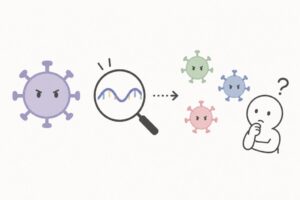
Why Does the Coronavirus Mutate So Easily?
“Another new variant?”
“Why do new types keep appearing one after another?”
Many people have probably wondered this about COVID-19.
In fact, the coronavirus is a virus that is naturally prone to mutation.
In this article, we’ll look at why this happens using familiar examples and as little technical language as possible.
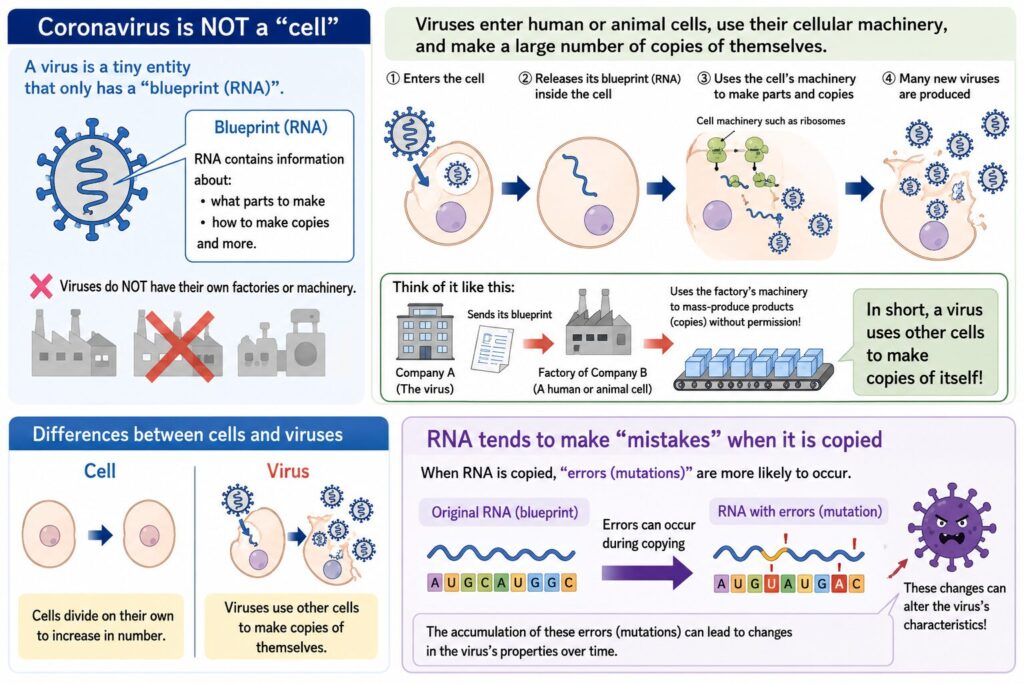
Coronaviruses Are Not “Cells”
Coronaviruses do not reproduce by dividing on their own like cells do.
A virus is an extremely tiny entity that mainly carries its own “blueprint.”
That blueprint is called RNA.
RNA contains information such as:
- what parts to make
- how to reproduce
However, the virus itself does not have the factory or machinery needed to build products from that blueprint.
So instead, it enters human or animal cells and uses the equipment inside those cells to produce large numbers of copies of itself.
A simple way to imagine this is:
A company secretly sends its own blueprints into another company’s factory and uses that factory’s equipment to mass-produce its own products.
In other words:
- Cells → reproduce by dividing themselves
- Viruses → use other cells to make copies of themselves
That is the key difference.
The RNA used in this process has another important characteristic:
it is prone to making copying “mistakes.”
The “Telephone Game” Makes It Easier to Understand
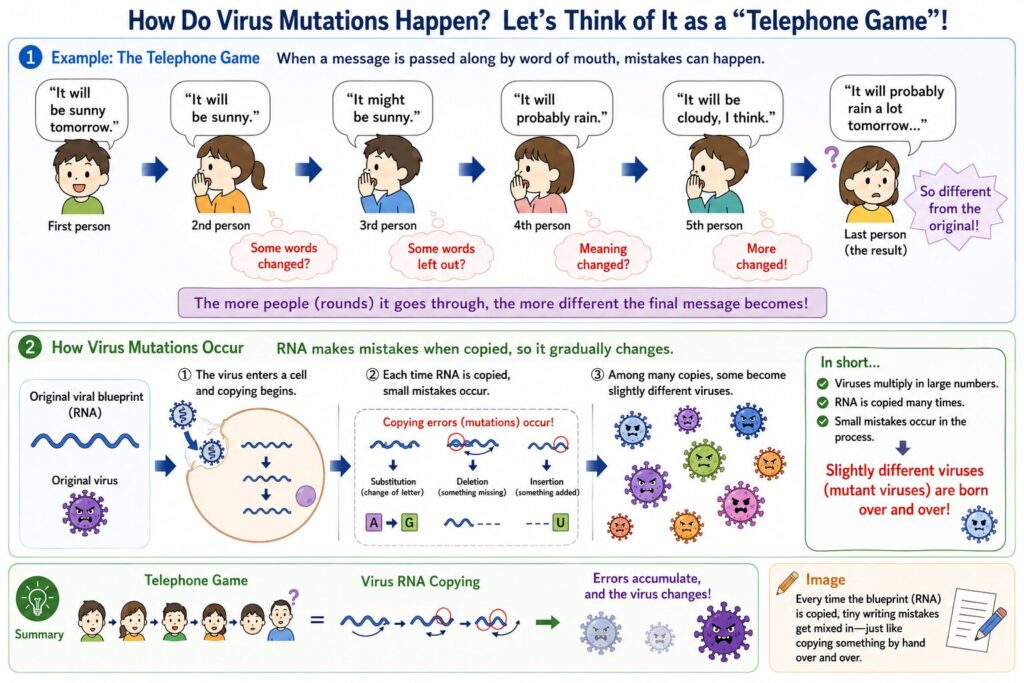
Imagine the game of telephone.
A message is passed from person to person only by speaking, so along the way:
- words may change
- parts may be left out
- meanings may shift slightly
As more people repeat the message, the final version can become quite different from the original.
Coronavirus mutations are similar to this process.
Compared with DNA, RNA has a weaker system for correcting copying mistakes.
As a result, small changes gradually occur each time the virus reproduces.
In other words:
- the virus reproduces in huge numbers
- its RNA is copied repeatedly
- small copying mistakes occur during the process
This gradually creates slightly different versions of the virus.
It is similar to repeatedly copying a design blueprint while tiny writing errors slowly accumulate.
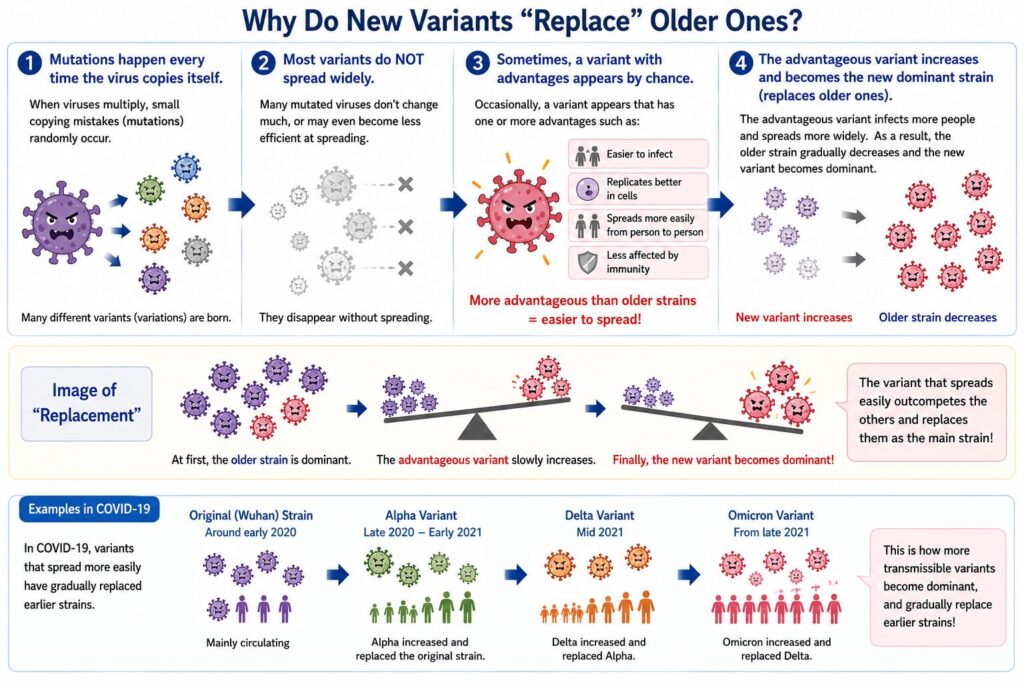
Why Do New Variants Replace Older Ones?
Not every mutated virus spreads widely.
Many mutations cause little change, while some actually make the virus weaker.
However, occasionally a variant appears that happens to have advantages such as:
- infecting people more easily
- reproducing more efficiently inside cells
- spreading more easily from person to person
- being less affected by immunity
When that happens, the new variant spreads more efficiently than previous ones and gradually becomes dominant.
As a result:
- older variants decline
- newer variants increase
This process is called “variant replacement.”
In fact, with COVID-19, variants gradually replaced one another over time:
- the original Wuhan strain
- Alpha
- Delta
- Omicron
Each became dominant because it spread more easily than the previous variant.
Summary
Coronaviruses do not reproduce by dividing like cells.
Instead, they use human cells to produce large numbers of copies of themselves.
Their blueprint is RNA.
However, RNA is prone to copying mistakes, so:
- the virus reproduces in huge numbers
- RNA is copied repeatedly
- small mistakes gradually accumulate
As a result, many different variants emerge.
Among them, variants that:
- spread more easily from person to person
- are less affected by immunity
gradually spread by replacing older strains.
Even though the idea of “variants” may sound complicated, it may become easier to understand if you think of it as:
“a message slowly changing during a game of telephone.”