
Is NISA Really a Perfect Investment Tool? — Important Considerations Beyond “Tax-Free” Benefits —
NISA has become widely popular in Japan as a system for building personal assets, and it is increasingly common to hear people say:
“First, you should start with NISA.”
Certainly, NISA offers significant advantages.
However, at the same time, there are many cases where the word “tax-free” receives most of the attention, while the characteristics and potential drawbacks of the system are not fully understood.
In this article, I would like to take another look at both the benefits and the important considerations of NISA.
The Biggest Advantage of NISA: Tax-Free Investment
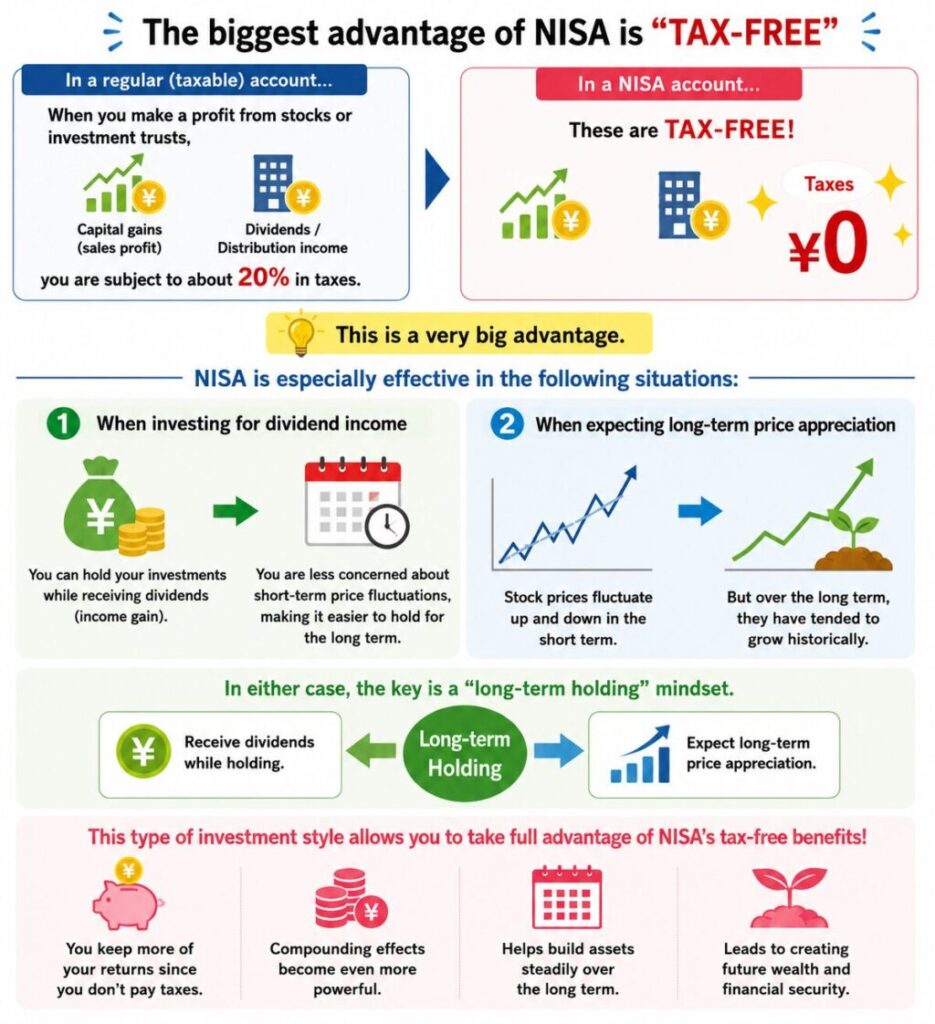
Normally, when you earn profits from stocks or investment trusts, approximately 20% tax is applied to:
- Capital gains
- Dividends and distributions
However, within a NISA account, these profits are tax-free.
This is an extremely significant benefit.
NISA may be especially effective for:
- Investors seeking dividend income
- Investors aiming for long-term capital appreciation
For dividend-focused investors, short-term stock price fluctuations may become less concerning, which can also encourage long-term holding.
In addition, although stock prices fluctuate in the short term, they have historically shown a tendency to grow over long periods of time.
Therefore, whether the goal is:
- Receiving dividends while holding investments
- Pursuing long-term price appreciation
the common and important concept is long-term investing.
This type of investment style is where the tax-free advantages of NISA may be most beneficial.
However, NISA Also Has Important Limitations
On the other hand, NISA also has disadvantages and points that require caution.
One major limitation is:
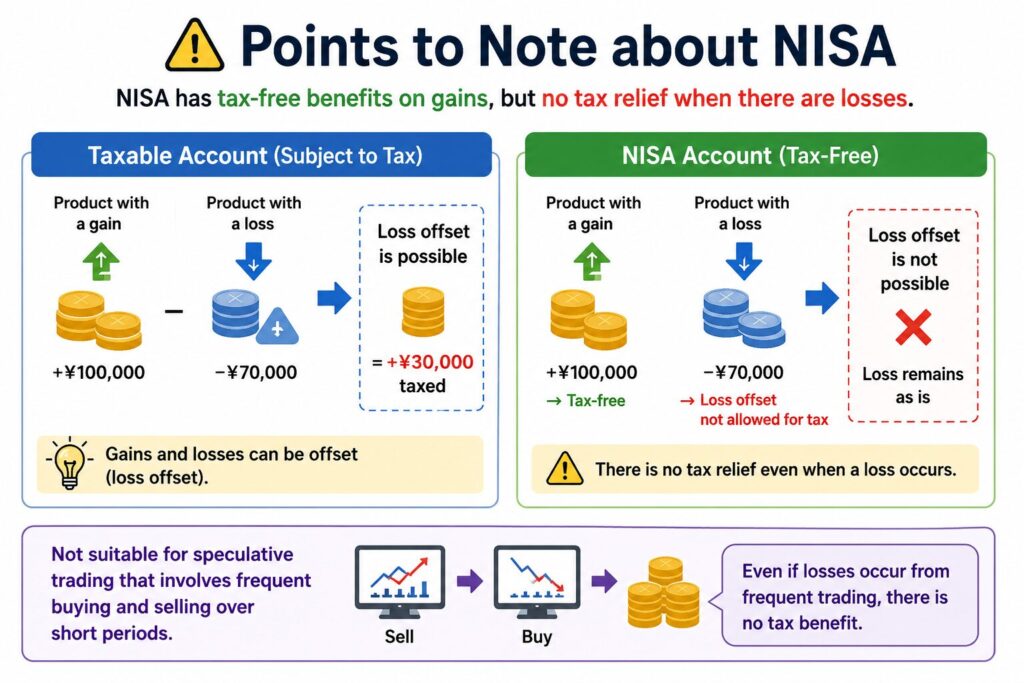
“Losses cannot be offset against gains.”
With a regular taxable investment account, it is generally possible to offset:
- Profits from one investment
- Losses from another investment
for tax purposes.
However, in a NISA account, losses cannot be used for tax-loss offsetting.
In other words:
“While profits receive tax-free benefits, there is no tax relief when losses occur.”
Because of this, NISA may not be well suited for speculative strategies involving frequent short-term trading.
The Most Important Thing Is Using NISA in a Way That Fits You
NISA is undoubtedly a very useful system.
However, it is not as simple as saying:
“Because it is tax-free, you will always benefit.”
What truly matters is using NISA in a way that matches your own situation while considering factors such as:
- Risk tolerance
- Asset allocation
- Investment horizon
- Balance with household finances
NISA may be best viewed as:
“A system for growing surplus funds over the long term.”
Using it gradually and within a comfortable financial range may be the most important approach.