Losing Weight, Part 3
Keep a Weight Graph Diary
Once you’ve become accustomed to weighing yourself every day, the next step is to start keeping a record.
Here, we’ll introduce a method called the “Weight Graph Diary.”
This method was developed mainly by Oita University. It is a form of behavioral therapy in which changes in body weight are visualized through graphs, helping people think about the causes of their weight fluctuations and improve their daily habits accordingly.
How Many Times a Day Should You Weigh Yourself?
Originally, this method involves measuring your weight four times a day. However, if you push yourself too hard, it becomes difficult to continue.
So first, start with a frequency that feels manageable.
The recommended schedule is:
- Right after waking up
(This is usually the lowest weight of the day.) - After dinner
(This is usually the highest weight of the day.)
That means measuring twice a day.
If even that feels difficult, measuring just once in the morning is perfectly fine.
It’s also okay if you cannot do it every single day.
What matters most is continuing within a range that feels sustainable for you.
As mentioned earlier in the section about rebound weight gain, difficult routines do not last long.
Don’t overdo it — build the habit little by little.
When Should You Measure Your Weight?
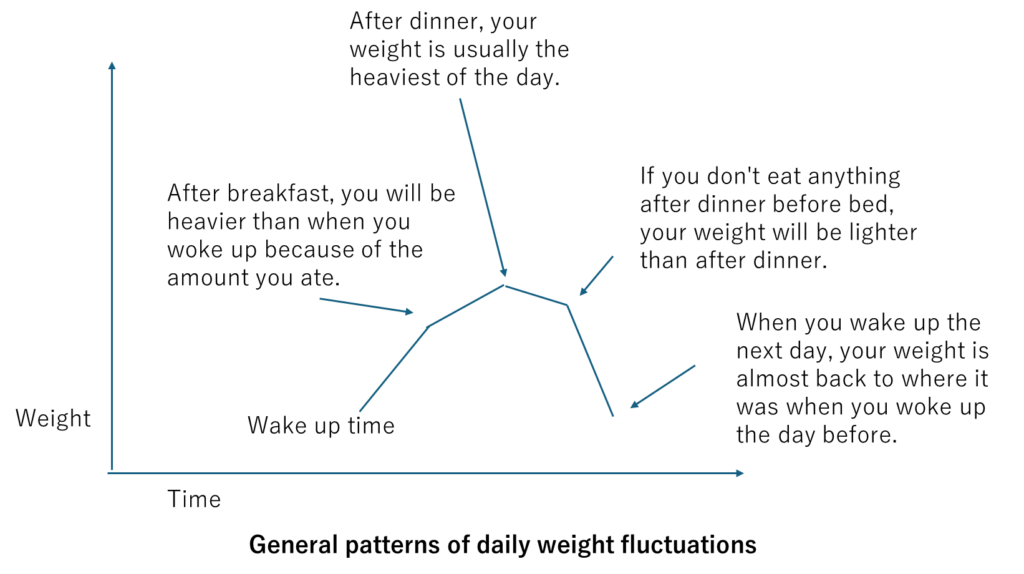
Ideally, weight should be measured at the following times:
- Right after waking up
(Usually the lightest weight of the day. Measuring after using the restroom is recommended.) - After breakfast
- After dinner
(Usually the heaviest weight of the day.) - Before going to bed
If that is too difficult, the following are also acceptable:
- Twice a day: after waking up and after dinner
- Once a day: only after waking up
What Can You Learn from Graphing Your Weight?
When you turn your measurements into a graph, you may begin to notice patterns such as:
- Your weight increases the day after overeating
- Your weight decreases on days when you are more active
- Eating out tends to make your weight increase
In this way, the relationship between weight changes and lifestyle habits becomes easier to see.
The important thing is to think for yourself:
- “Why did my weight increase?”
- “Why did it decrease?”
Tips for Keeping Records
After measuring your weight, record it on the graph as soon as possible.
Then connect the new measurement to the previous one with a line.
Connecting the points with lines is important.
Doing so makes changes in weight visually easier to understand, and it also helps you notice how those changes relate to your lifestyle at the time.
On the other hand, if you record everything later all at once, it becomes harder to remember why your weight increased or decreased.
At First, Simply Getting Used to It Is Enough
You do not need to create a perfect graph from the beginning.
First, focus on getting used to the habit of:
- Measuring your weight
- Recording it
- Looking at the graph
There is no need to rush.
Take your time and continue steadily.