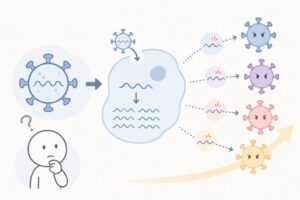
About COVID-19 Antigen Test Kits
When experiencing symptoms such as fever or a sore throat, many people may wonder:
“Could this be COVID-19?”
and use a COVID-19 antigen test kit.
Recently, various types of antigen test kits have become commercially available, including:
- Nasal swab type
- Saliva type
- Diagnostic-use kits
- Research-use kits
As a result, many people may have questions such as:
- “Which type is more accurate?”
- “If the result is negative, does that really mean I am not infected?”
In our case, a family member tested positive for COVID-19, so antigen testing was started before symptoms appeared. After symptoms subsequently developed, additional testing was performed to follow the clinical course over time.
Based on these observations, we examined:
- Whether there is a difference between nasal and saliva test kits
- Whether there is a difference between diagnostic-use and research-use kits
- How soon after infection antigen tests become positive
Please note that this was a personal observation involving only a small number of cases and was not conducted as a formal scientific study. The findings should therefore be considered for reference only.
Ⅰ. Is There a Difference Between Nasal and Saliva Antigen Tests?
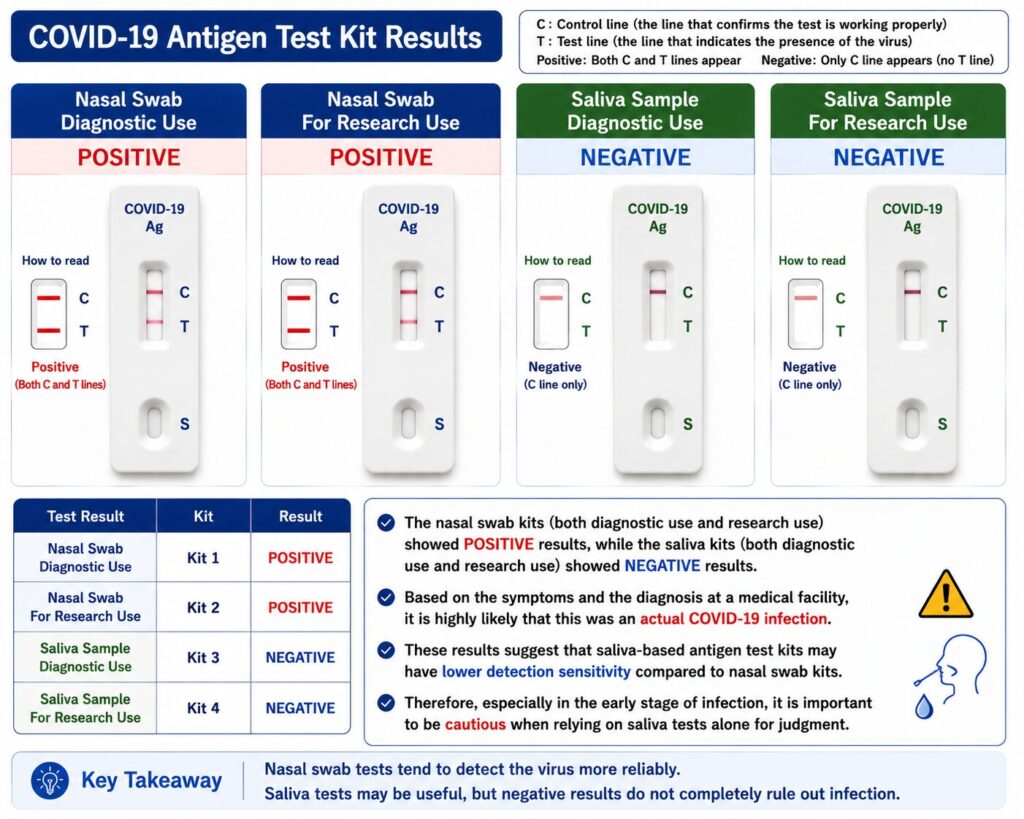
First, we present the results obtained using nasal and saliva antigen test kits after symptom onset.
Test Results
| Kit Type | Result |
|---|---|
| Nasal / Diagnostic-use | Positive |
| Nasal / Research-use | Positive |
| Saliva / Diagnostic-use | Negative |
| Saliva / Research-use | Negative |
Both diagnostic-use and research-use nasal kits produced positive results, whereas both saliva-based kits were negative.
Considering the symptoms and the diagnosis made at the medical institution, COVID-19 infection was considered highly likely.
These findings suggest that saliva-based antigen tests may have lower sensitivity compared with nasal swab tests.
Therefore, caution may be necessary when relying solely on saliva-based kits, especially during the early phase of infection.
Illustration
Ⅱ. Is There a Difference Between Diagnostic-Use and Research-Use Kits?
Next, we present the results obtained using diagnostic-use and research-use nasal antigen test kits.
Test Results
| Kit Type | Result |
|---|---|
| Diagnostic-use | Positive |
| Research-use | Positive |
In this small observational case, the research-use kit produced results similar to those of the diagnostic-use kit.
Three different research-use products purchased through Amazon were also tested, and all showed similar findings.
However, research-use kits are not officially approved for medical diagnosis, and their quality and performance are not publicly guaranteed.
Therefore, when making medical decisions, diagnostic-use kits or testing performed by medical institutions should be prioritized.
Nevertheless, research-use kits may still have some value for supplementary purposes, such as monitoring the course of illness.
Ⅲ. When Do Antigen Tests Become Positive After Infection?
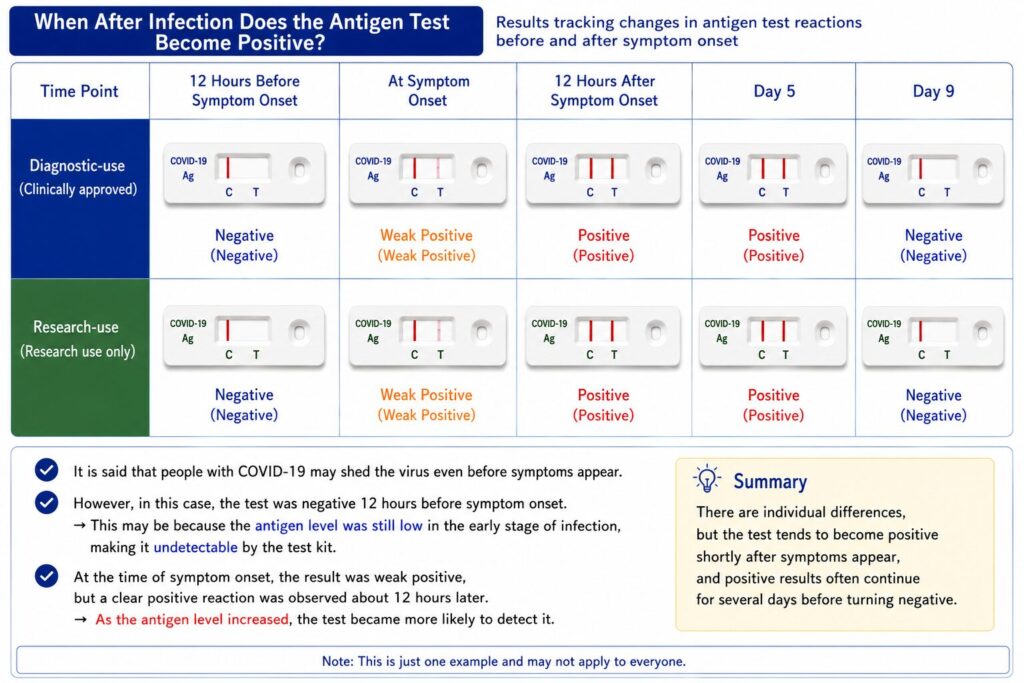
Next, we followed how antigen test results changed before and after symptom onset.
Test Results
| Timing | Diagnostic-use | Research-use |
|---|---|---|
| 12 hours before symptom onset | Negative | Negative |
| At symptom onset | Weak positive | Weak positive |
| 12 hours after symptom onset | Positive | Positive |
| Day 5 | Positive | Positive |
| Day 9 | Negative | Negative |
It has been reported that people infected with COVID-19 may begin shedding virus before symptoms appear.
However, in this case, the antigen tests remained negative 12 hours before symptom onset.
One possible explanation is that, during the early stage of infection, the amount of viral antigen was still too low to be detected by the test kits.
At the time symptoms first appeared, only weak positive reactions were observed, but clear positive reactions became evident approximately half a day later.
Illustration
A Negative Antigen Test Does Not Necessarily Mean “No Infection”
One important point highlighted by these observations is that:
“A negative antigen test does not completely rule out COVID-19 infection.”
In particular, when circumstances strongly suggest possible COVID-19 infection — such as:
- A family member being infected
- Presence of fever
- Severe fatigue
— the viral antigen level may still be too low to detect at the time of testing, resulting in a false-negative result.
In other words, it is important to evaluate not only the test result itself, but also the overall clinical situation.
Summary
These observations suggest the following:
- Saliva-based antigen tests may have lower sensitivity than nasal swab tests
- Research-use kits may produce results similar to diagnostic-use kits in some cases
- Antigen tests can remain negative during the early phase of infection, so a negative result does not necessarily mean absence of infection
Final Thoughts
Physicians do not make diagnoses based solely on test results.
In many cases, doctors first narrow down the likely diagnosis through medical history and symptoms, and then use physical examinations and laboratory tests to confirm their clinical judgment.
Therefore, even if a test result is negative, a patient may still be considered highly likely to have COVID-19 based on factors such as:
- Symptoms
- Exposure history
- Infection status of surrounding individuals
The important point in medical testing is not simply the result itself, but also:
- Why the test is being performed
- How the result should be interpreted
It is important to understand that test results alone do not tell the whole story.
I hope this article helps readers better understand and appropriately use COVID-19 antigen test kits.