4. How Much Should You Hold in Risk Assets?
— A Simple Framework Based on “Lifestyle Decline” —
Thinking About Risk
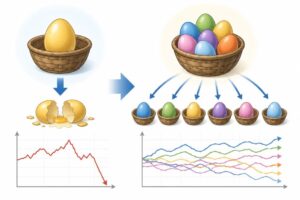
One of the most difficult questions in personal finance is how to balance safe assets (cash and bank deposits) and risk assets (stocks, mutual funds, etc.).
There is no single correct answer, as the appropriate allocation varies significantly depending on factors such as life stage and income level.
Here, as one way of thinking about risk assets, we will refer to the ideas of financial commentator Hajime Yamazaki and consider risk tolerance from the perspective of “decline in living standards.”
In investing, “risk” does not simply mean danger; rather, it refers to the magnitude of price fluctuations.
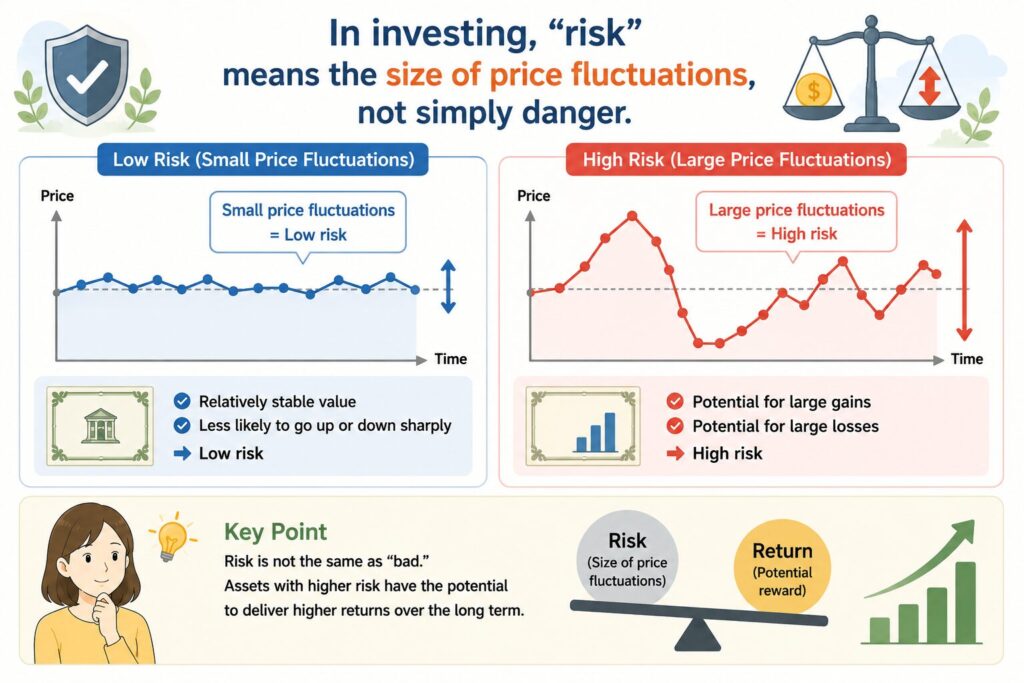
According to Yamazaki, risk tolerance can be thought of as:
“How much decline in living standards you are willing to accept.”
For example, suppose that during retirement:
“A decline in living standards of about 10,000 yen per month would be acceptable.”
Assuming a retirement period of 30 years:
10,000 yen × 12 months × 30 years = 3.6 million yen
This can be considered a rough estimate of the total decline in living standards that could be tolerated over the long term.
Converting It Into Investment Amount (Simple Model)
Global equity index funds have historically delivered positive long-term returns, although they have also experienced temporary declines of around 30%.
For simplicity, let us assume:
- Acceptable loss: 3.6 million yen
- Assumed market decline: 30%
Under these assumptions:
3.6 million yen ÷ 30% ≈ 12 million yen
This represents a theoretical example of an investment amount under the assumptions that:
- “A decline in living standards of about 10,000 yen per month is acceptable”
- “The maximum drawdown is 30%”
Of course, actual risk tolerance differs significantly from person to person, and the appropriate amount depends on factors such as income, family structure, and overall financial situation.
Guideline for Monthly Investing
Suppose that a person invests a fixed amount every month over a 40-year period, from the beginning of employment until retirement.
If the target total investment amount is 12 million yen:
12 million yen ÷ 40 years ÷ 12 months ≈ 25,000 yen
Therefore, as a simple rule of thumb:
Investing around 20,000 to 30,000 yen per month
can be considered one possible guideline.
Conclusion
- Risk should be understood not as the “amount of loss,” but as its “impact on daily life.”
- If a decline in living standards of about 10,000 yen per month is acceptable, one rough estimate of investment capacity would be around 12 million yen.
- In terms of regular investing, this corresponds to roughly 20,000–30,000 yen per month.
- However, the appropriate level of risk varies greatly from person to person.
Ultimately:
It is important to take risks only within a range that you can sustain over the long term.
This article is not intended as investment advice, but rather as one way of thinking about risk tolerance.