
What Is Metabolic Syndrome? — Its Close Relationship with Atherosclerosis
In recent years, “specific health checkups,” commonly known as “metabolic syndrome screenings,” have become well established in Japan.
However, while many people have heard the term “metabolic syndrome,” relatively few may fully understand what it actually means.
In this article, I would like to explain, in simple terms, what metabolic syndrome is and how it is related to atherosclerosis.
Factors That Cause Atherosclerosis
As atherosclerosis progresses, it can lead to life-threatening conditions such as stroke and myocardial infarction (heart attack).
For this reason, lowering LDL cholesterol (“bad” cholesterol) has long been an important focus in the prevention of atherosclerosis.
In recent years, however, it has become clear that diabetes, hypertension, elevated triglycerides, and obesity are also major risk factors for heart attack and stroke.
Furthermore, research has shown that, in addition to improving blood sugar and blood pressure, addressing visceral fat itself is also extremely important.
The Important Role of Fat Cells
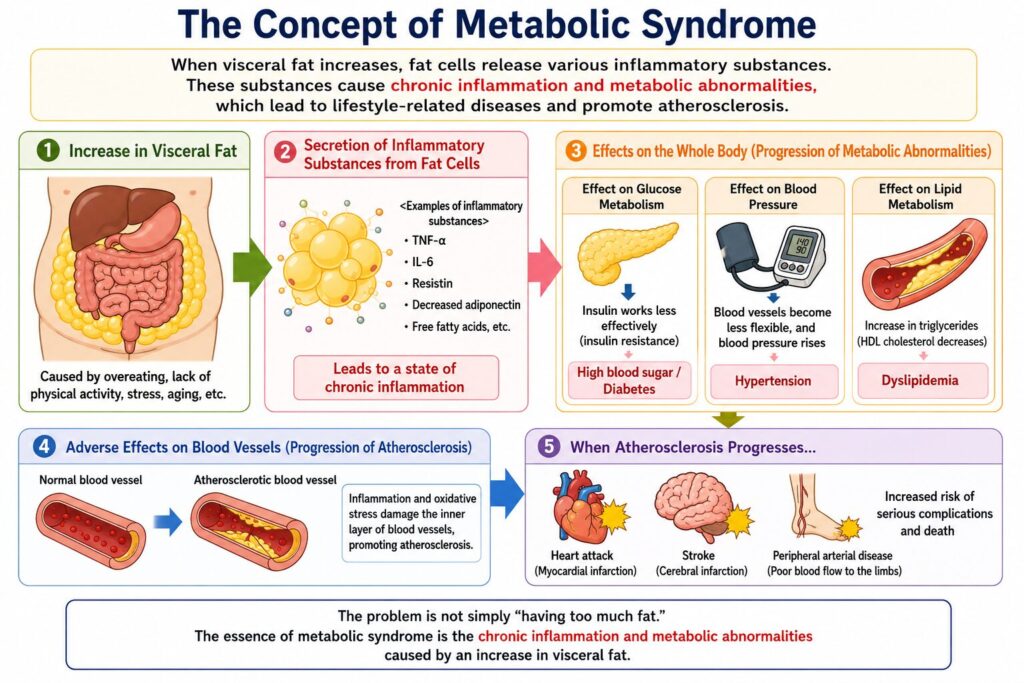
When we consume more energy than we use through overeating or lack of exercise, the excess energy is stored in the body as fat.
As fat accumulates, fat cells begin releasing various inflammatory substances.
These substances are believed to contribute not only to diabetes and hypertension, but also to direct damage to blood vessels, thereby accelerating atherosclerosis.
In other words, the problem is not simply “having too much fat.”
Rather, chronic inflammation and metabolic abnormalities caused by excess visceral fat are considered to be central features of metabolic syndrome.
Treating high blood pressure or diabetes is certainly very important.
However, in some cases, controlling blood pressure and blood sugar alone may not sufficiently reduce the risk of atherosclerosis.
This is because, when visceral fat remains excessive, fat cells continue to release inflammatory substances that can adversely affect blood vessels.
Therefore, preventing atherosclerosis requires not only controlling blood pressure and blood sugar, but also improving lifestyle habits in order to reduce visceral fat.
In this sense, treatment of metabolic syndrome is not merely about “improving laboratory numbers.”
It is also about reducing visceral fat and improving the underlying condition that makes blood vessels more vulnerable to damage.
Why Isn’t LDL Cholesterol Included in the Diagnostic Criteria for Metabolic Syndrome?
When people think of atherosclerosis, many first think of LDL cholesterol (“bad” cholesterol).
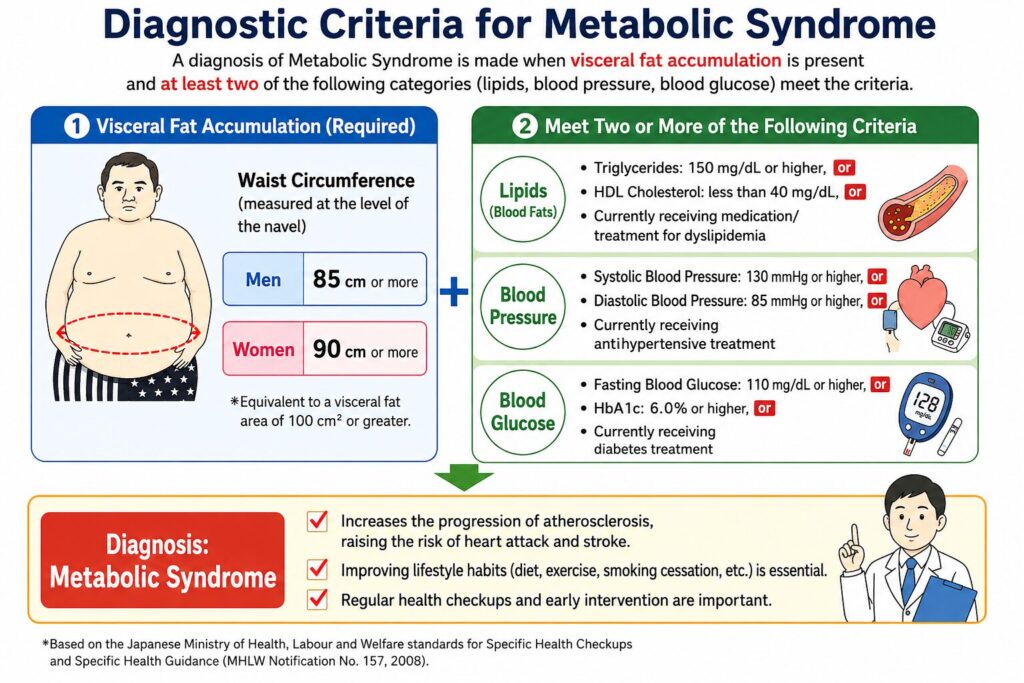
However, LDL cholesterol itself is not included in the diagnostic criteria for metabolic syndrome.
Why is that?
Thinking of Blood Vessels as Water Pipes
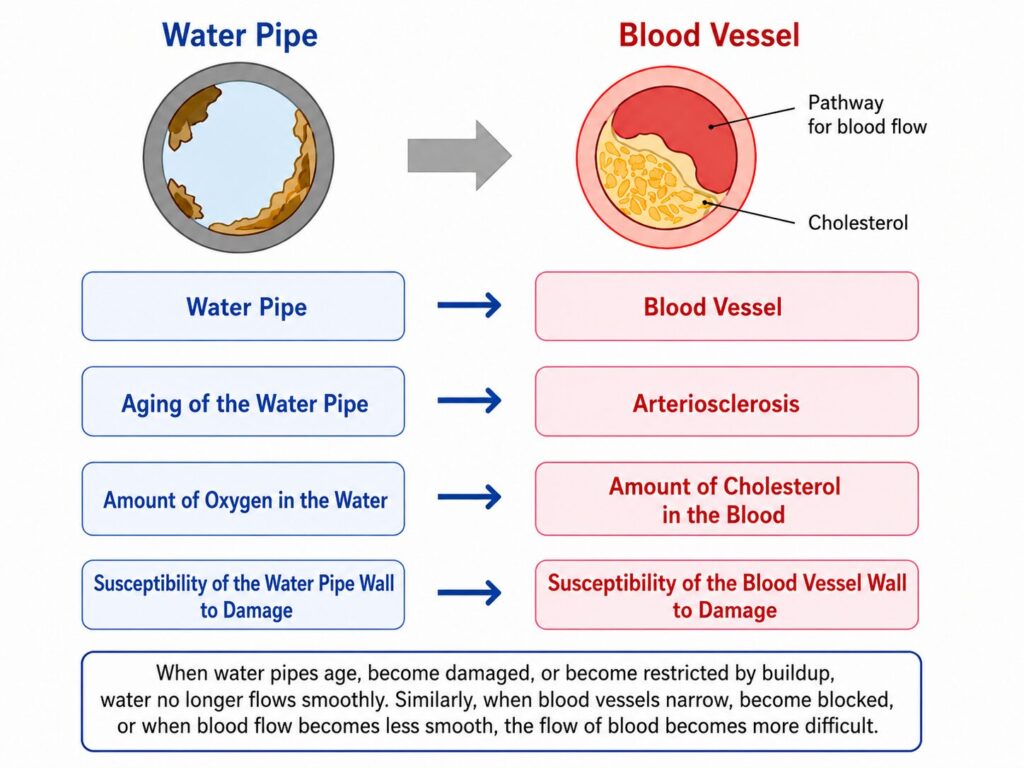
Let’s think of blood vessels as water pipes.
Water pipes that have been used for many years will gradually rust. There are two major factors involved in the rusting of water pipes:
- The amount of oxygen in the water flowing through them
- The susceptibility of the pipes to damage
If a pipe is damaged, it will rust easily even if there is little oxygen in the water. Conversely, if a pipe is sturdy, it is less likely to rust.
The same applies to blood vessels. If a blood vessel is damaged, it is easier for cholesterol to enter the vessel wall, which promotes arteriosclerosis (hardening of the arteries). Conversely, if the vessel wall is strong, it is harder for cholesterol to enter, making it more difficult for arteriosclerosis to progress.
In other words, the relationship between the rusting of water pipes and arteriosclerosis is as follows:
- Susceptibility of the pipe to damage = Susceptibility of the blood vessel to damage
- Amount of oxygen in the water = Amount of cholesterol in the blood
Ultimately, the factors that cause arteriosclerosis are:
- The amount of LDL cholesterol in the blood
- The susceptibility of the blood vessels to damage
Metabolic syndrome serves as an indicator for the latter—the susceptibility of blood vessels to damage.
Thus, LDL cholesterol and metabolic syndrome look at the risks of arteriosclerosis from different perspectives. This is why LDL cholesterol is not included in the diagnostic criteria for metabolic syndrome. Therefore, to prevent the progression of arteriosclerosis, it is important to both manage LDL cholesterol and improve lifestyle habits to reduce the visceral fat that causes metabolic syndrome.
The Key to Improving Metabolic Syndrome: Reducing Visceral Fat
So, how can we protect our blood vessels?
The key is to reduce the harmful substances released by fat cells.
To achieve this, it is necessary to reduce fat tissue—especially visceral fat.
Compared with subcutaneous fat, visceral fat is considered relatively responsive to diet and exercise.
Therefore, improving metabolic syndrome requires:
- Reviewing dietary habits
- Engaging in regular moderate exercise
- Maintaining an appropriate body weight
Lifestyle Changes Should Be Sustainable
If you have been told that you have metabolic syndrome or are at risk for it, it is important to review your daily lifestyle habits.
However, extreme dieting may lead to rebound weight gain and can even harm your health.
In addition, some medical conditions may require restrictions on exercise.
It is therefore important to proceed gradually and in consultation with your physician to find an approach that is appropriate for your individual condition.
Conclusion
Metabolic syndrome is not simply a matter of being overweight.
It is a condition in which visceral fat accumulation leads to metabolic abnormalities and chronic inflammation that place stress on blood vessels and accelerate atherosclerosis.
To help prevent future stroke and heart attack, it is important not only to manage blood pressure, blood sugar, and cholesterol, but also to improve lifestyle habits in ways that reduce visceral fat.
Small daily improvements in diet and exercise can make a major difference to long-term health.
I hope to discuss diet and exercise therapy in greater detail on another occasion.