5. How to Choose Investment Products: What Should You Invest in as Risk Assets?
Basic Concepts of Risk and Diversification
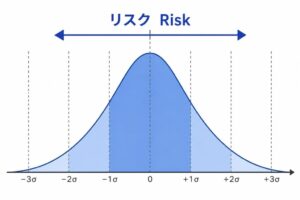
The term “risk” often carries the impression of danger, but in finance it generally refers to the magnitude of price fluctuations.
For example, if Company A’s stock price is 5,000 yen and its risk level is around 10%, the price may fluctuate around that level, moving within a range of approximately 4,500 to 5,500 yen.
This is a statistical estimate based on historical data, and in reality, the price can move even more significantly.
The Risk of Concentrated Investment in Individual Stocks
If you hold only Company A’s stock, your assets will be heavily dependent on that company’s performance.
For example:
- Declining earnings
- Corporate scandals
- Industry-wide downturns
In such cases, the value of your assets may fall significantly.
The Concept of Diversification
This is where “diversification” becomes important.
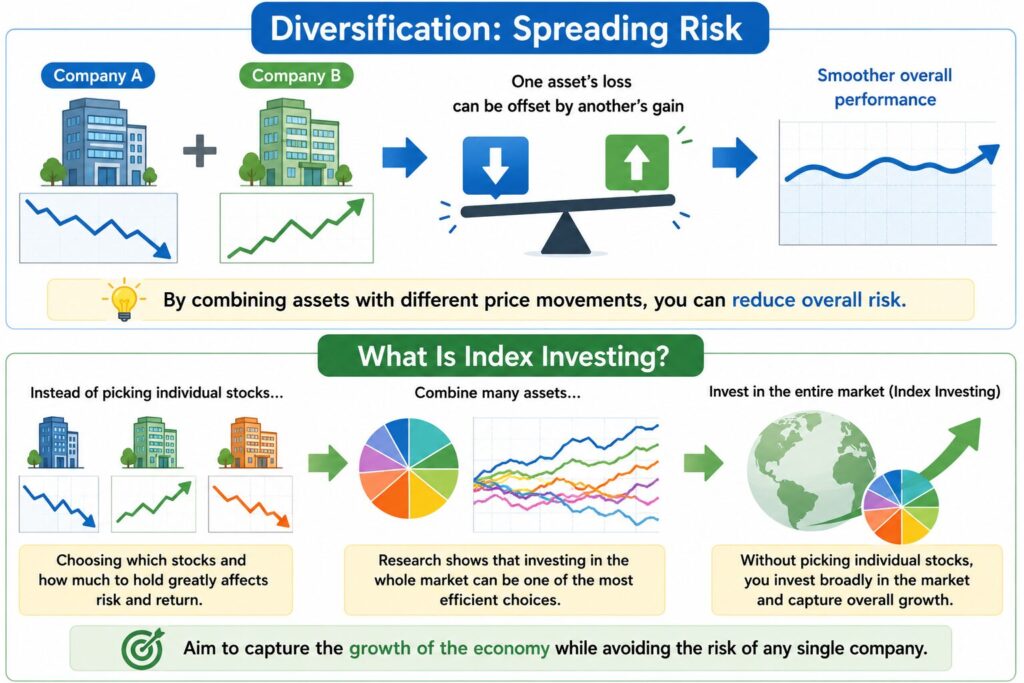
For example, if you also hold shares in Company B:
- When Company A declines, Company B may rise
- Or losses in one may be offset by gains in the other
In this way, fluctuations in the overall portfolio can be reduced.
In other words:
By combining assets with different price movements, overall risk can be reduced.
What Is Index Investing?
As financial research has progressed, it has become clear that:
- Which stocks to choose
- In what proportions to combine them
can significantly affect the balance between risk and return.
Within this context, investing in a broad collection of assets representing the entire market has come to be regarded as one efficient approach. This is known as “index investing.”
Index investing means:
- Not selecting individual companies
- Instead, investing broadly across the entire market
This approach aims to reduce company-specific risk while capturing overall economic growth.
Why a Global Stock Index?
Extending this idea further leads to the concept of:
Diversifying not just within one country, but across the entire world.
A global stock index includes companies from:
- The United States
- Europe
- Japan
- Emerging markets
This approach helps to:
- Reduce dependence on any single country
- Capture global economic growth
- Diversify regional risks
Diversified Investing for Individual Investors
In the past, investing globally required a large amount of capital.
However, today:
- Index funds
- ETFs
allow individual investors to achieve global diversification with relatively small amounts of money.
Conclusion
In investing, “risk” does not mean the possibility of losing money, but rather the degree of price fluctuation.
The most fundamental way to reduce this risk is diversification.
By spreading investments across countries and companies rather than concentrating in a single one, investors can reduce large fluctuations while capturing long-term global economic growth.
For this reason, a global stock index is widely considered one of the most rational choices for long-term wealth building.