
When You Can No Longer Make Your Own Decisions Part 2. What Happens to Your Bank Account If You Develop Dementia? — Planning for Future Asset Management —
As people grow older, conditions such as dementia can make it increasingly difficult for them to manage their own finances and assets.
“If you develop dementia, your bank account will be frozen and you will no longer be able to withdraw money.”
Many people may have heard statements like this.
However, being diagnosed with dementia does not automatically mean that all banking transactions will immediately be suspended.
The key issue is whether the person has the mental capacity to understand and judge the consequences of their own actions (mental capacity).
In this article, we will look at what problems may arise with bank accounts and asset management when dementia or another condition makes communication and financial management difficult, and why it is important to prepare while you are still able to make decisions for yourself.
1. Why Can a Bank Account Become Difficult to Use When a Person Has Dementia?
Article 3-2 of the Japanese Civil Code provides as follows:
“A juridical act performed by a person who lacked the mental capacity to understand the legal consequences of their actions at the time of expressing their intention is void.”
“Mental capacity” refers to the ability to understand and judge what consequences will result from one’s actions.
Withdrawing money from a bank account is also a legal act. If a transaction is carried out when the account holder does not have sufficient mental capacity, the transaction may be considered invalid.
For this reason, when a bank receives a request for a withdrawal or other transaction, it must confirm the account holder’s intentions and verify that anyone acting on the account holder’s behalf has legitimate authority to do so.
If the bank cannot confirm the account holder’s intentions and a family member or other person does not have proper authority to manage the funds, the bank may have no choice but to restrict transactions.
This is what is commonly referred to in Japan as “freezing a bank account due to dementia.”
2. A Dementia Diagnosis Does Not Mean the Account Is Immediately Frozen
This point is often misunderstood.
Banks do not automatically receive information about a dementia diagnosis and freeze an account on the day the diagnosis is made.
Dementia varies greatly in severity. Even after being diagnosed, some people are still fully capable of understanding their financial affairs and making decisions about their assets.
Conversely, regardless of the specific diagnosis, if a person cannot understand the nature of a transaction or the bank cannot confirm their intentions, it may be difficult for the bank to proceed with the transaction.
For example, the same issue could arise if someone becomes unconscious following a traffic accident and is unable to communicate their wishes.
Therefore, what matters is not the diagnosis of dementia itself, but whether the person has sufficient mental capacity at the time of the transaction.
3. This Is Different from an Account Freeze Following Death
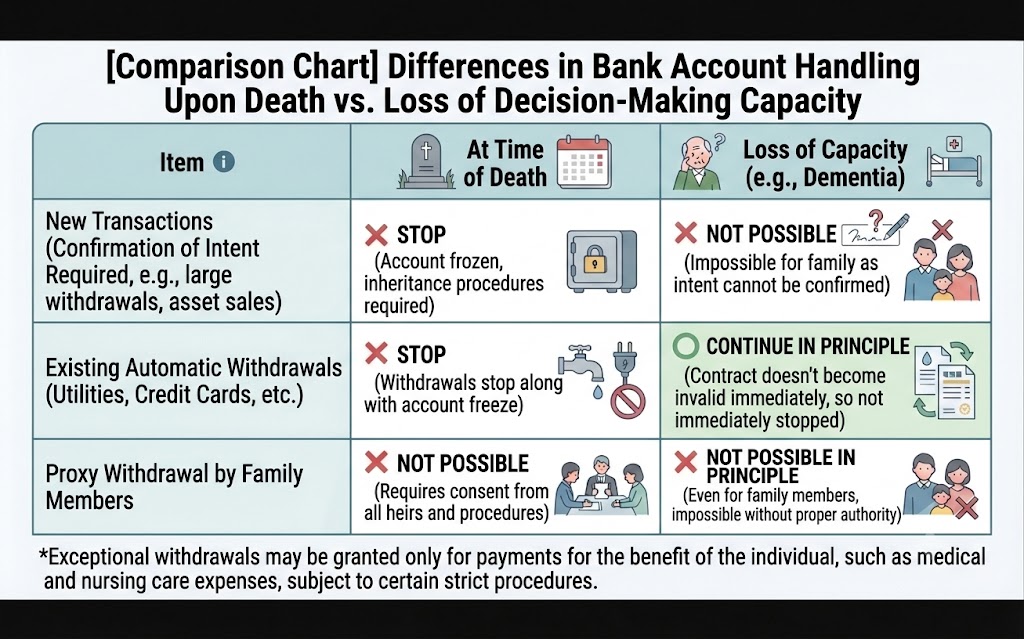
Bank accounts are handled differently when the account holder has died and when the account holder is alive but has lost mental capacity due to dementia or another condition.
If the Account Holder Dies
Once the bank confirms the account holder’s death, transactions on the account are generally suspended, and inheritance procedures are required.
In Cases of Dementia or Similar Conditions
Because the account holder is still alive, automatic payments that were arranged before the onset of the condition—such as utility bills, credit card payments, or care facility fees—do not necessarily stop immediately.
This is because contracts that were already validly established do not automatically become invalid.
Problems are more likely to arise with transactions that require a new confirmation of the account holder’s intentions.
Examples include withdrawing a large amount of money, selling real estate, or terminating financial products.
Once the account holder is no longer able to understand the meaning of such transactions and complete the necessary procedures, a family member cannot simply act on their behalf solely because they are family.
4. Being a Family Member Does Not Necessarily Mean You Can Withdraw the Money
Suppose a parent develops dementia and needs a substantial amount of money to move into a nursing care facility. The parent has sufficient savings to cover the cost.
The child goes to the bank and says:
“I need to withdraw money from my father’s account to pay for his care.”
Even in this situation, the child cannot freely withdraw money simply because they are the account holder’s child.
The money in the account remains the property of the account holder.
This is not because the bank distrusts the family. Rather, banks have an important responsibility to protect customers’ assets from being moved or used by people who do not have legitimate authority to do so.
Exceptions May Apply to Medical and Long-Term Care Expenses
Under guidelines issued by the Japanese Bankers Association, banks may, in exceptional circumstances, allow family members to access funds for payments that are clearly for the benefit of the account holder, such as medical or long-term care expenses, subject to strict procedures and verification.
However, documentation and confirmation are still required, and the funds cannot be freely used for any purpose. Therefore, this should not be regarded as a fundamental solution to the problem.
Money is needed for the account holder’s benefit, yet the account holder cannot express their wishes, and the family cannot access the funds.
This illustrates one of the major difficulties of managing assets when a person develops dementia.
5. The Greater the Need for Care, the Greater the Need to Manage Money
Another problem is that the period when a person’s decision-making ability declines often coincides with the period when more money needs to be spent on their behalf.
As dementia progresses, various expenses may arise, including long-term care services, admission to a care facility, medical expenses, and home maintenance costs.
In some cases, it may be necessary to sell the person’s home to help cover the cost of care.
However, by that time, the person may no longer be able to understand the terms of a contract.
“The assets exist, but they cannot be used for the benefit of the person who owns them.”
To avoid such a situation, it is important to consider future asset management while the person still has sufficient decision-making capacity.
6. There Are More Options While a Person Still Has Mental Capacity
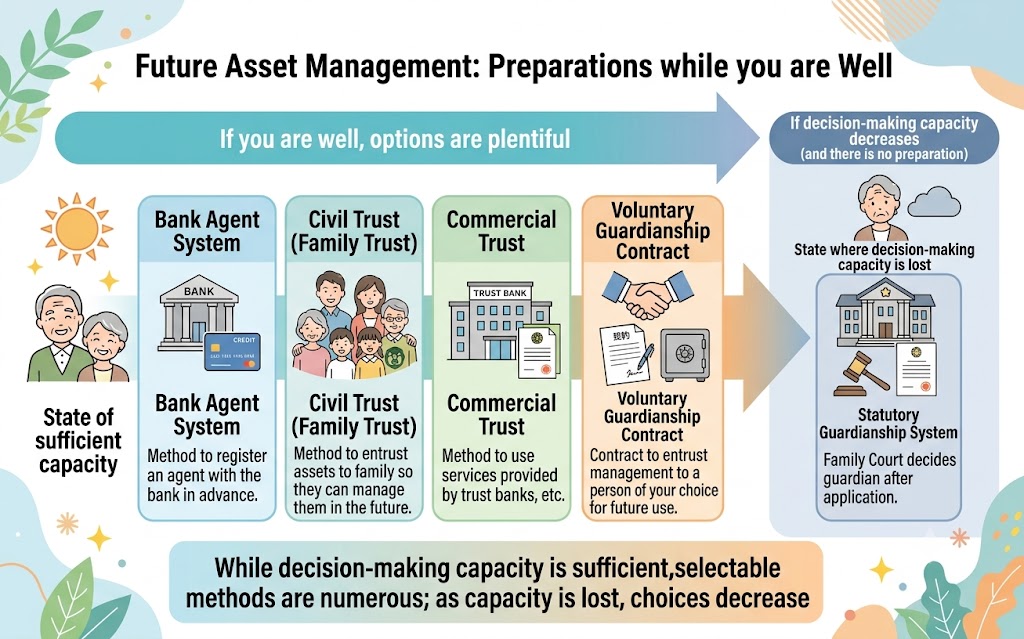
While a person still has sufficient mental capacity, various arrangements can be made in advance.
Bank Proxy or Authorized Representative System
An arrangement in which an authorized representative is registered with the bank in advance.
Civil Trust (Family Trust)
An arrangement in which assets are entrusted to a family member or another person so that they can continue to be managed in the future.
Commercial Trust
A trust service provided by a trust bank or another professional financial institution.
Voluntary Guardianship Agreement
An agreement made in advance under which a person chosen by the individual will manage their assets and other affairs if their decision-making ability declines in the future.
On the other hand, if no arrangements have been made before the person loses sufficient decision-making capacity, an important option is to apply to the Family Court for the use of Japan’s statutory adult guardianship system.
In other words:
While a person still has sufficient decision-making capacity, there are many options available. As that capacity is lost, the range of available options becomes more limited.
7. Conclusion: Waiting Until Dementia Develops May Be Too Late to Plan Asset Management
When people think about preparing for dementia, medical treatment and long-term care may be the first things that come to mind.
However, receiving medical treatment and long-term care also requires access to money.
And the question of “who will manage that money, and under what legal authority?” may become difficult to address once the person’s decision-making ability has already declined, because some arrangements can no longer be made at that stage.
What matters is thinking in advance about the question:
“If I can no longer manage my own assets, who will manage them for me?”
There is no single solution.
Options range from relatively simple bank proxy arrangements to civil (family) trusts, commercial trusts, and adult guardianship systems. Each has a different structure and purpose.
Rather than one system being universally better than another, the most appropriate option will depend on the person’s assets, family circumstances, and the type of support they may need in the future.
And this is not only an issue related to dementia.
A traffic accident or other unexpected event could leave even a younger person unconscious and unable to express their wishes. In such a situation, it may also become difficult for others to access or manage money in that person’s bank account.
If you become unable to manage your own assets in the future, who will manage them, and under what authority?
This is an issue that everyone—not only older people—should consider at least once.
Coming Next
In the next article, we will take a closer look at three ways to arrange for someone else to manage your assets while you still have sufficient decision-making capacity: bank proxy arrangements, civil (family) trusts, and commercial trusts, and examine their differences and key features.