
When You Can No Longer Make Your Own Decisions Part 3. Preparing for Dementia: Entrusting the Management of Your Assets
Bank Proxy Services, Civil (Family) Trusts, and Commercial Trusts
In the previous article, I explained that when a person’s decision-making capacity declines due to dementia or other causes, it may become difficult for them to freely manage or use their own assets.
In this article, I will look at several ways to prepare in advance, while you are still healthy and capable of making decisions, so that someone else can manage your assets in the future. The main topics are bank proxy services, civil (family) trusts, and commercial trusts.
The Most Familiar Option: Bank Proxy Services
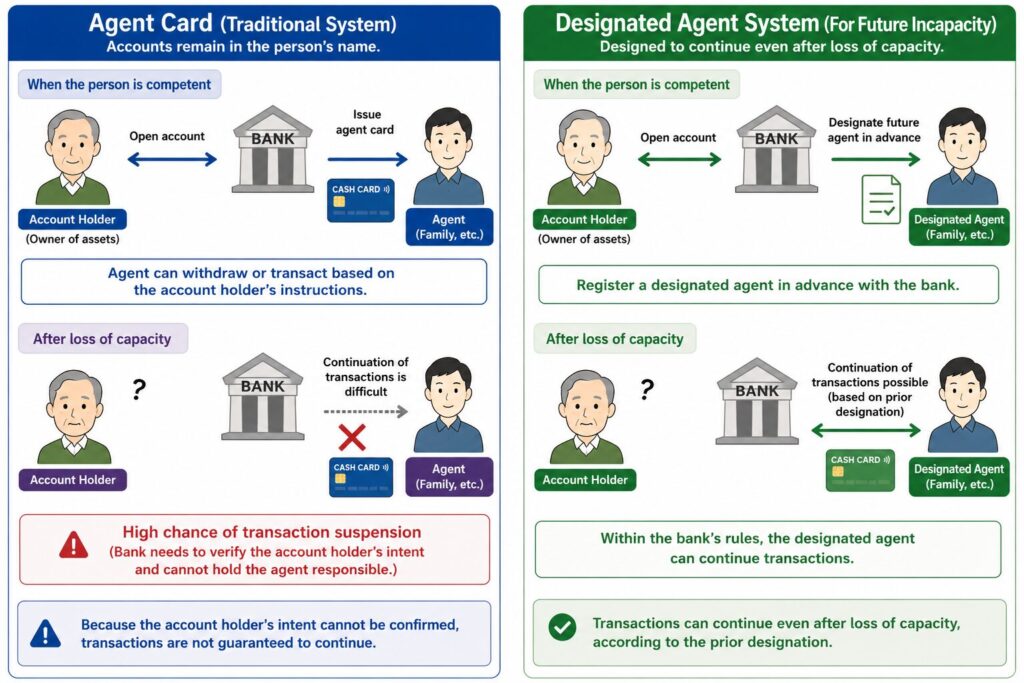
One way to have a family member manage your bank account is through a proxy card system, which has been available for many years.
The account holder can complete the necessary procedures and designate a family member or another person as a proxy. The bank can then issue a cash card for the proxy, allowing that person to withdraw money from the account on the account holder’s behalf.
However, traditional proxy card systems have had a significant limitation.
The fact that a proxy has been designated does not necessarily mean that the proxy can continue to conduct transactions after the account holder loses decision-making capacity.
This is because a traditional proxy card is based on the assumption that the proxy withdraws money according to the account holder’s wishes, with the account holder ultimately responsible for the transactions carried out by the proxy.
Once the account holder can no longer express their wishes, it may become difficult for the bank to confirm the account holder’s intentions or to establish that transactions are being carried out based on those intentions. For this reason, the use of a traditional proxy card may be restricted or stopped.
Bank Proxy Services Designed for Dementia
In recent years, some financial institutions have introduced systems designed specifically to address this issue.
Under these systems, while the account holder is still healthy and capable of making decisions, they can designate a person in advance who will act as their proxy in the future. Even after the account holder’s decision-making capacity has declined, the designated proxy may be able to conduct certain banking transactions.
Compared with traditional proxy cards, these systems can be viewed as a step toward preparing in advance for future dementia or a decline in decision-making capacity.
However, this is not a legal trust.
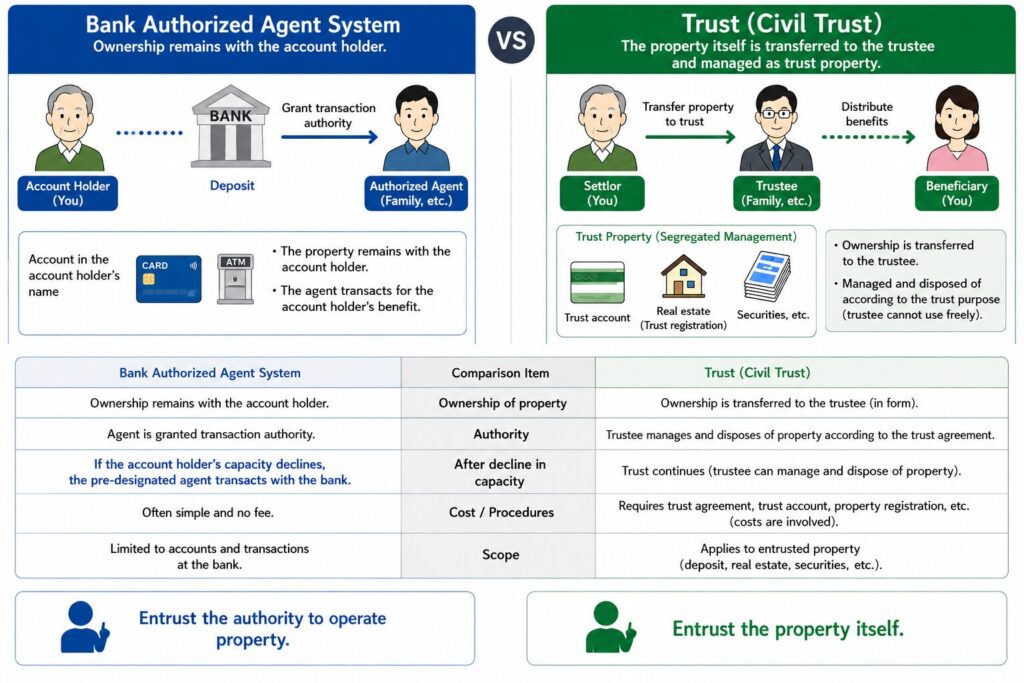
With a trust, the assets placed in the trust are transferred to the trustee for management. With a bank proxy service, on the other hand, the assets, such as deposits, remain the property of the account holder.
The proxy is simply given certain authority to conduct transactions.
In other words:
It does not entrust the assets themselves.
It entrusts the authority to manage and move the assets.
Even so, these systems are similar to trusts in the sense that a person can decide while still healthy, “I want this person to manage my money for me in the future.”
One of the biggest features of this type of bank proxy service is that, unlike a trust, the account holder can continue to manage their own account while they retain decision-making capacity. If their capacity later declines, the person designated in advance can manage the account within the permitted scope.
Trusts work differently. Depending on the terms of the trust, the trustee generally manages the assets that have been placed in the trust. Because ownership of the trust assets has formally been transferred to the trustee, the person who originally owned the assets cannot simply manage them as freely as before.
Bank proxy services are often free of charge, making them potentially easier to use than a trust.
However, they mainly cover assets held at that particular bank and therefore do not provide a system for managing all of a person’s assets.
What Is a Civil (Family) Trust?
A more comprehensive way to entrust asset management to a family member or another person is a civil trust.
Because family members often serve as trustees, civil trusts are also commonly referred to as “family trusts.”
For example, a father can place part of his assets into a trust managed by his eldest son and enter into a trust agreement stating:
“After I develop dementia, I want you to manage these assets for my living expenses and long-term care.”
In this case:
- The father who entrusts the assets is the settlor.
- The eldest son who manages the assets is the trustee.
- The person who benefits from the assets is the beneficiary — in this example, the father, who is also the settlor.
In other words, the person can create a system in which, if they eventually become unable to manage their own assets, a family member manages those assets on their behalf and uses them for the person’s living expenses and care.
A Trust Entrusts the Assets Themselves
This is one of the major differences between a bank proxy service and a trust.
With a bank proxy service, the assets remain the property of the account holder, while another person is given authority to conduct certain transactions.
With a trust, the assets placed in the trust are transferred to the trustee, who manages them as trust assets.
Put simply, ownership is formally transferred from the settlor to the trustee.
However, this does not mean that the trustee can freely use the assets as their own. Because ownership has been transferred to the trustee, the settlor can no longer freely manage those assets as their own.
This is a major difference from a bank proxy service.
Although legal ownership of the trust assets is formally transferred to the trustee, the trustee must keep those assets separate from their own property and manage or dispose of them according to the purpose and terms of the trust. This is known as separate management of trust assets.
For money, a dedicated trust account, such as a trust account at a financial institution, may be used to clearly identify the funds as trust assets.
When real estate is placed in a trust, the transfer of ownership and registration of the trust are carried out so that it is clear that the property is held as trust property.
Using a dedicated trust account and registering the transfer of real estate involve costs. There are also costs for having a professional prepare the trust agreement. These expenses can make establishing a trust a significant hurdle.
The fact that the assets themselves are entrusted to the trustee is the fundamental difference between a trust and simply giving someone authority to act as a bank proxy.
The Trust Continues Even If You Develop Dementia
One reason civil trusts are used as a way to prepare for dementia is that even if the settlor’s decision-making capacity declines after the trust agreement has been established, the trustee can continue to manage the trust assets according to the terms of the trust.
For example, suppose a parent places their home in a trust while they are still healthy and creates a system stating:
“If I eventually move into a care facility, sell this house and use the proceeds to pay for my care.”
If the parent’s dementia later progresses and they become unable to enter into a real estate sales contract themselves, the trustee can, within the scope of the trust agreement, manage and dispose of the trust property.
Because ownership has formally been transferred to the trustee, the trustee can manage the property according to the trust agreement without requiring the parent to enter into the transaction themselves.
A Trust Cannot Cover Everything
A trust is not a universal solution.
First, a trust only covers the assets that have actually been placed in the trust.
A trustee does not automatically gain the authority to manage all of a person’s assets simply because that person has established a trust.
It is therefore necessary to decide in advance which bank deposits, real estate, securities, or other assets will be placed in the trust.
Furthermore, being a trustee does not mean that the trustee can carry out every contract or procedure on behalf of the person.
The trustee can manage and dispose of the entrusted assets, but cannot, for example, automatically enter into a nursing-home admission contract or handle medical procedures and other personal matters on behalf of the person.
This is an important difference from the adult guardianship system, which I will discuss later.
Choosing the Right Trustee Is Important
With a civil trust, a family member or another person close to the settlor can serve as the trustee.
Compared with having a professional manage the assets on an ongoing basis, using a family member as trustee may reduce continuing management costs.
However, the trustee has responsibilities.
The trustee must keep the trust assets separate from their own assets and manage them according to the purpose of the trust.
The trustee is also required to keep appropriate records and make the management of the trust assets transparent.
Simply because someone is a family member does not mean that they can be entrusted with the assets without careful consideration.
Depending on the family relationships and the nature of the assets, giving one family member substantial authority over the assets may also lead to conflicts later.
Commercial Trusts Managed by Financial Institutions
Instead of entrusting assets to a family member, it is also possible to entrust them to a professional trust institution, such as a trust bank or trust company.
A trust conducted as a business by a professional trustee in return for trust fees is generally referred to as a commercial trust.
Some products designed to prepare for dementia allow the person to receive a fixed amount of money each month from the trust assets for living expenses. Others may allow family members or other designated persons to complete procedures so that the trust assets can be used to pay medical or long-term care expenses when needed.
Because a professional financial institution serves as the trustee, one major advantage is that the family does not have to take on the burden of managing the trust assets themselves.
On the other hand, some products require a minimum amount of assets to be placed in the trust, and there may be initial fees and ongoing trust management fees.
In addition, packaged products offered by financial institutions may have lower costs, but they may also place certain restrictions on the terms of the trust and how the funds can be used.
How Are Bank Proxy Services, Civil Trusts, and Commercial Trusts Different?
All three methods have something in common: they can be used to prepare for the future management of a person’s assets.
However, the mechanisms are quite different.
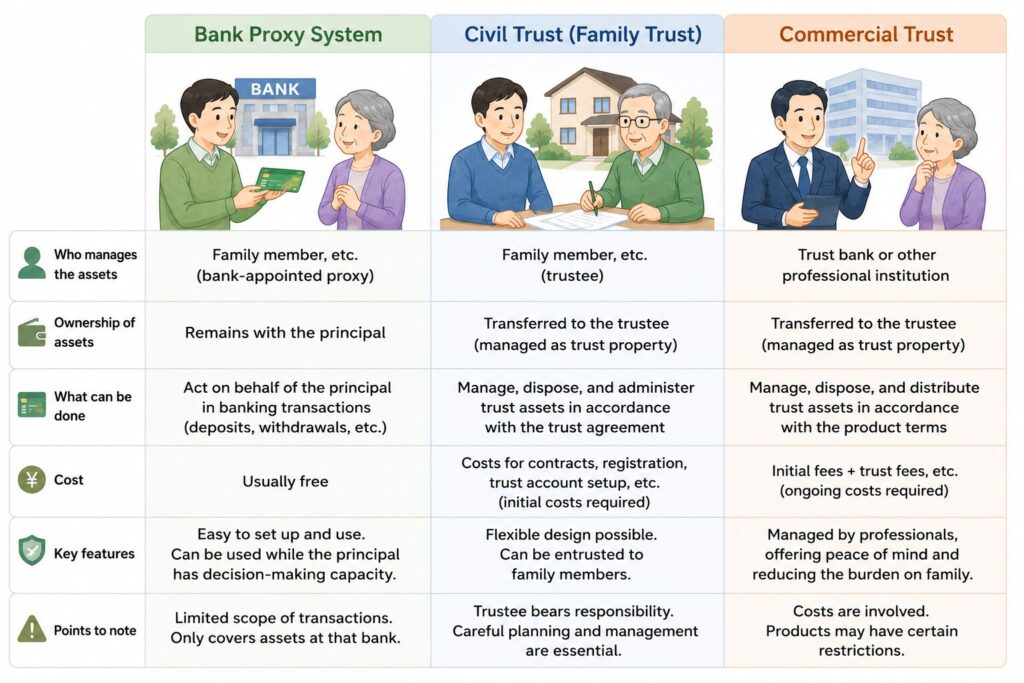
- A bank proxy service keeps the assets in the person’s own name while giving another person authority to conduct certain transactions. It is often available free of charge.
- A civil trust entrusts assets to a family member or another trustee, who manages them according to the purpose of the trust. Costs may arise from preparing the trust agreement, transferring assets, registering real estate, and establishing a dedicated trust account.
- A commercial trust entrusts assets to a professional institution, such as a trust bank or trust company. Instead of a family member, a professional third party manages the assets, generally for a fee.
A bank proxy service is relatively simple, but the assets and transactions that can be covered may be limited.
A civil trust allows for flexible arrangements, but it requires someone who is willing and able to serve as trustee, and careful consideration is needed when designing the trust and managing the assets.
A commercial trust allows the assets to be managed by a professional institution, but it involves fees and may have restrictions depending on the product.
Therefore, there is no single option that is universally better than the others.
“Who,” “What,” and “How Much” Should You Entrust?
When planning for the future management of your assets, the important thing is not to choose a system simply because of its name.
First, consider:
Who do I want to manage my assets?
Then:
Which assets do I want to entrust?
And:
How much authority do I want to give them after my decision-making capacity declines?
If the main concern is everyday banking transactions, a bank proxy service may be sufficient in some cases.
If you want to give a family member flexible authority to manage assets, including real estate, a civil trust may be an option.
If you want to avoid placing a major burden on your family and would prefer to have a professional institution manage your money, a commercial trust may be another option.
However, there are things that these systems alone cannot cover.
When a person’s decision-making capacity has declined, a system that allows someone to enter into contracts or manage assets that were not placed in the trust on that person’s behalf becomes important.
This is where the adult guardianship system becomes relevant.
In the next article, I will look at the differences between voluntary guardianship and statutory guardianship, explain how guardianship differs from trusts, and consider how the two systems can be combined.