Is Only Shishamo from Hokkaido the “Real” Shishamo? The Difference Between Shishamo and Capelin
When I visited Hokkaido, I came across a sign at a local shop that said:
“Only fish caught in Hokkaido can be called shishamo.”
I was surprised.
So, does that mean that all the “shishamo” we buy at supermarkets come from Hokkaido?
When I looked into it, I discovered something quite interesting.
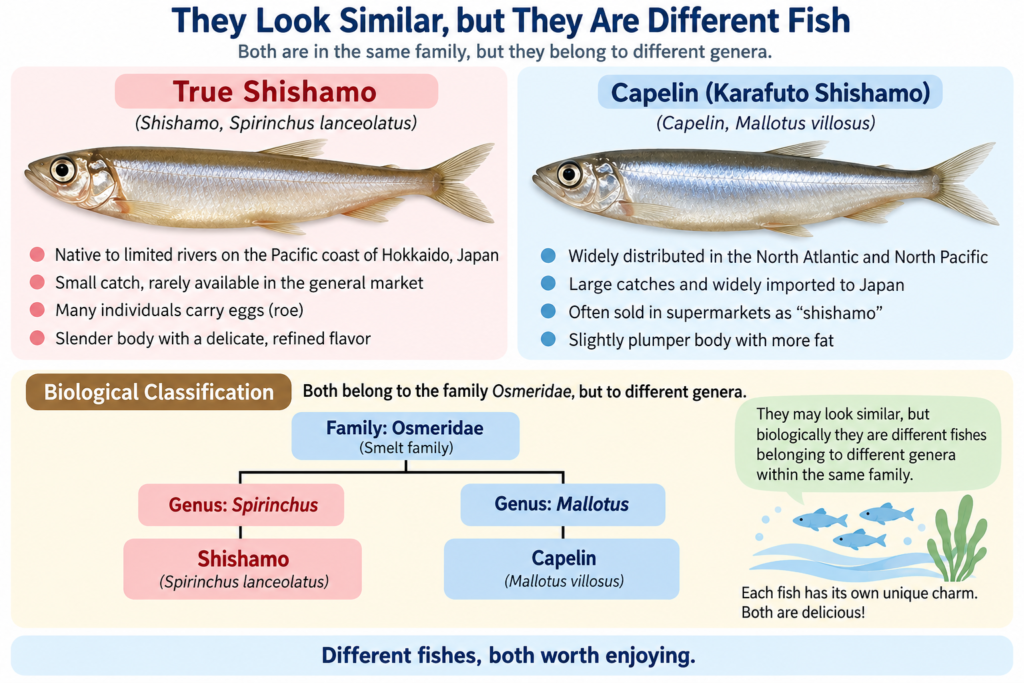
In fact, true shishamo is a fish native to Japan and lives only in a limited number of rivers along the Pacific coast of Hokkaido. Because the catch is relatively small, genuine shishamo is not widely distributed throughout Japan.
This is where capelin comes in.
Capelin is widely distributed in areas such as the North Atlantic and North Pacific. Because it can be caught in large quantities, it is imported into Japan in substantial amounts.
As a result, much of what is commonly eaten as “shishamo” in Japan today is actually capelin. Japan’s Ministry of Agriculture, Forestry and Fisheries also explains that most of the shishamo sold throughout Japan is imported capelin.
However, on supermarket labels and other food packaging, it is generally identified as “karafuto shishamo” or “capelin.”
What makes this even more interesting is their biological classification.
Both genuine shishamo and capelin belong to the smelt family (Osmeridae), but they belong to different genera.
Shishamo
→ Family: Osmeridae
→ Genus: Spirinchus
→ Species: Shishamo
Capelin
→ Family: Osmeridae
→ Genus: Mallotus
→ Species: Capelin
In other words, they belong to the same family but to different genera.
This is somewhat similar to the relationship between dogs and foxes.
Both belong to the dog family (Canidae), but dogs belong to the genus Canis, while true foxes belong mainly to the genus Vulpes.
Of course, biological classification is a system created by humans based on shared characteristics and evolutionary relationships.
It is not as though God drew a line and said, “From this point on, this is a different genus.”
So, while it is certainly interesting to learn about the differences in classification, there is no need to think that capelin is somehow inferior simply because it is not genuine shishamo.
Capelin is inexpensive, and when it contains roe, you can also enjoy the texture of the eggs. There is nothing wrong with simply enjoying it for what it is.
What about their nutritional value?
What about the nutritional differences between the two?
When their nutritional profiles are compared, capelin contains slightly more EPA and DHA, making it a somewhat better choice if your main goal is to obtain these omega-3 fatty acids.
On the other hand, genuine shishamo has a slight advantage if you are looking for a high-protein, lower-fat option.
That said, there is no dramatic difference in their nutritional content.
It is certainly not the case that eating genuine shishamo is the only way to obtain meaningful health benefits.
You can enjoy genuine shishamo when visiting Hokkaido, or choose affordable capelin for everyday meals.
Once you know the difference, why not simply enjoy each one for what it is?