
Your Lungs May Never Fully Recover: What Smokers Who Think “I’m Fine for Now” Should Know About Emphysema
The Harmful Effects of Smoking
Smoking is often described as having “a hundred harmful effects and not a single benefit,” and its association with a wide range of diseases is well established.
When people think about smoking-related diseases, lung cancer may be the first thing that comes to mind.
However, lung cancer is not the only serious disease caused by smoking. In this article, I would like to focus on one of the harmful effects of smoking: emphysema.
The Structure of Healthy Lungs
Before discussing emphysema, let’s first picture what healthy lungs look like.
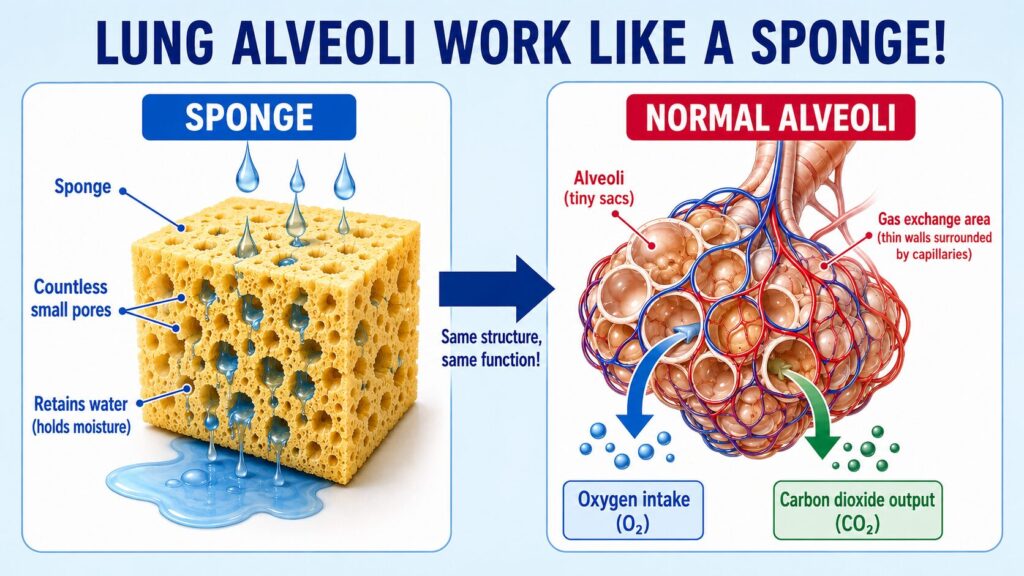
Healthy lungs have a sponge-like structure.
A sponge contains many tiny holes, separated from one another by thin walls.
The lungs are similar. They are made up of countless tiny structures called alveoli, which are small air sacs. Just as in a sponge, thin walls separate the individual alveoli. These are called alveolar walls.
Air that we breathe in from outside enters the alveoli. Tiny blood vessels run through the thin walls between the alveoli.
Oxygen and carbon dioxide are exchanged between the air inside the alveoli and the blood flowing through the alveolar walls.
In other words, the alveoli are the essential sites of gas exchange, taking oxygen from the air into the bloodstream and releasing carbon dioxide from the blood into the air.
What Happens in Emphysema?
So, what happens to the lungs when emphysema develops?
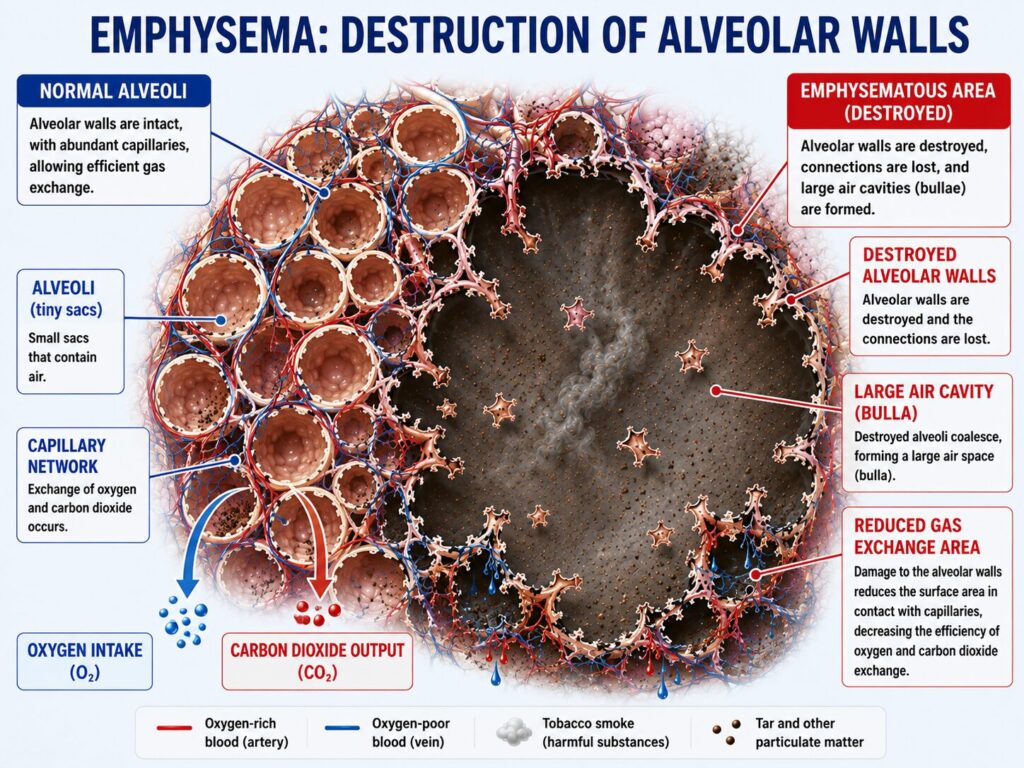
When a sponge absorbs water, water enters its many small holes. But if the walls between those holes are destroyed, several small holes merge into one large hole. As a result, the sponge has fewer areas capable of effectively taking in and holding water.
Something similar happens in the lungs.
When the walls between the alveoli are destroyed, neighboring alveoli merge together, and the many small air sacs gradually become larger spaces.
As a result, the surface area available for oxygen and carbon dioxide exchange decreases, making it more difficult for the lungs to perform gas exchange efficiently.
Consequently, the lungs become less able to take in enough oxygen and remove carbon dioxide from the body.
This is emphysema.
Smoking Is the Leading Cause of Emphysema
Emphysema can have various causes, including exposure to dust and chemicals and genetic factors.
However, smoking is the most important cause. In fact, smoking is estimated to account for about 90% of cases of chronic obstructive pulmonary disease (COPD), which includes emphysema.
The many harmful substances in cigarette smoke cause chronic inflammation in the lungs, gradually damaging lung tissue. The walls between the alveoli are also progressively destroyed.
The most important point I want to emphasize is this:
Once the walls of the alveoli have been destroyed, they cannot return to their original condition.
Therefore, continuing to smoke can cause irreversible damage to the lungs. Secondhand smoke may also have similar harmful effects on the lungs of people around smokers, even if they do not smoke themselves.
What Happens as Emphysema Progresses? The Trap of Being “Symptom-Free”
As emphysema progresses, you may begin to experience shortness of breath even with relatively minor physical activity.
As the disease advances further, everyday activities such as climbing stairs or walking can cause significant breathlessness, making it increasingly difficult to move around as you would like.
But there is something particularly concerning about emphysema:
Even when the lungs are already being damaged, symptoms may not appear immediately.
The lungs have a remarkably large reserve capacity.
As a result, especially when people are young, they may have some degree of lung damage without noticing much difficulty in their everyday lives.
“I’m not short of breath now, so I’m fine.”
Even while thinking this, however, continuing to smoke means that damage to the lungs is steadily accumulating. By the time symptoms become obvious, the lung tissue may already have suffered considerable damage.
That Is Why Quitting Smoking Matters—Now
Let’s summarize the key points:
- Continuing to smoke causes cumulative damage to the lungs.
- When lung tissue is destroyed, it becomes more difficult to take in oxygen, resulting in shortness of breath.
- Even as lung damage progresses, symptoms may not appear immediately.
- By the time symptoms become noticeable, lung function may already have significantly declined.
- Secondhand smoke may also affect the health of the people around you.
Rather than thinking, “I feel fine now, so there’s nothing to worry about,” it is important to quit smoking before symptoms appear. Once lung tissue has been destroyed, it cannot be restored to its original condition.
However, quitting smoking can prevent further damage to the lungs and slow the decline in lung function.
Instead of thinking, “I’ll quit someday,” why not consider making the choice to quit now, while you still have no symptoms?
Practical Steps Toward Quitting Smoking
If you want to quit but feel that doing so on your own would be difficult, consider the following approaches:
- Visit a smoking cessation clinic: You can work toward quitting with support from a physician. If you meet certain conditions, smoking cessation treatment may be covered by health insurance.
- Use smoking cessation aids: Nicotine patches and nicotine gum can help reduce withdrawal symptoms, such as irritability.
Quitting smoking is an important step toward protecting your lungs from breathlessness in the future.
Why not take a moment to start thinking about the health of your lungs—and what you can do to protect them?