
Why Do Osteoporosis and High Cholesterol Become More Common After Menopause?
In this article, I would like to discuss some of the changes that occur after menopause, focusing on osteoporosis and high cholesterol.
Estrogen: A Hormone That Protects the Female Body
Women have an important biological role in pregnancy and childbirth. For this reason, estrogen plays an important role in maintaining reproductive function.
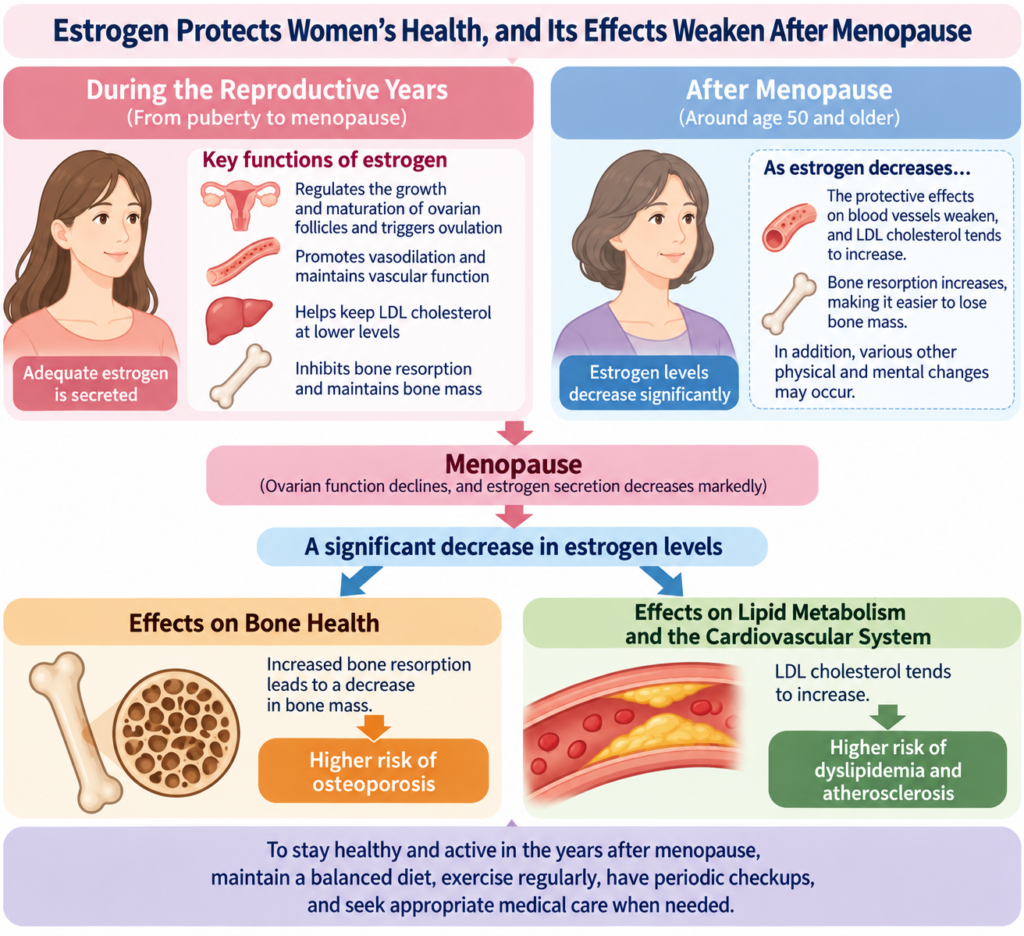
Estrogen has a variety of functions, including:
- Regulating the development of ovarian follicles and ovulation
- Promoting the growth of the uterine lining in preparation for pregnancy
- Promoting blood vessel dilation and helping maintain vascular function
- Helping keep LDL cholesterol levels low
- Suppressing bone resorption and helping maintain bone mass
As you can see, estrogen is not simply a “hormone for getting pregnant.”
In addition to supporting the reproductive functions necessary for pregnancy and childbirth, estrogen also helps maintain the overall condition of the body, including the blood vessels and bones.
The cardiovascular system, in particular, is placed under considerable strain during pregnancy, as blood volume and cardiac output increase. Because estrogen helps maintain vascular function and contributes to keeping LDL cholesterol levels low, it can be considered one of the factors that support a woman’s body during the reproductive years.
Why Does Menopause Occur?
So, what would happen if estrogen continued to be produced throughout a woman’s entire life?
If reproductive function were maintained as women aged, pregnancy and childbirth could potentially continue. However, the physical burden and risks associated with pregnancy and childbirth generally increase with age.
At the same time, ovarian function gradually declines with age, and the number of ovarian follicles decreases.
In other words, the female body has a mechanism that brings reproductive function to an end at a certain stage of life rather than maintaining it indefinitely.
This is menopause.
After menopause, ovulation and menstruation cease, and estrogen production by the ovaries decreases significantly.
The end of reproductive function at a certain age may also have a biological significance in avoiding pregnancy and childbirth at an advanced age.
However, there is one important issue here.
What Happens When Estrogen Levels Decline?
Before menopause, estrogen helps maintain various functions of the body.
When estrogen levels decline significantly with menopause, these effects become weaker.
Two important examples are bone health and lipid metabolism.
Estrogen suppresses bone resorption. Therefore, when estrogen levels decline, bone resorption increases, making a loss of bone mass more likely.
Estrogen also contributes to keeping LDL cholesterol levels low. As a result, LDL cholesterol tends to increase after menopause.
In other words:
Menopause
↓
A significant decline in estrogen
↙ ↘
Increased bone resorption LDL cholesterol tends to increase
↓ ↓
Higher risk of osteoporosis Higher risk of dyslipidemia
These are some of the changes that can occur after menopause.
What Is Menopausal Disorder?
Estrogen does not suddenly drop to zero at menopause. Around the time of menopause, estrogen levels fluctuate considerably before gradually declining.
During this period, women may experience a variety of symptoms, including hot flashes, sweating, palpitations, dizziness, headaches, and mood changes.
When these symptoms become severe enough to interfere with daily life, the condition is referred to as menopausal disorder.
Therefore, menopausal disorder is not simply caused by “a lack of estrogen.” Rather, it is thought to result from various physical and autonomic nervous system changes occurring against the background of fluctuations and decline in estrogen levels.
Living Longer After Menopause
Let us consider menopause once again from a biological perspective.
During the reproductive years, estrogen helps maintain not only reproductive function but also the bones and blood vessels.
As reproductive function comes to an end with age, estrogen production also declines significantly.
From the perspective of reproduction, this is a natural biological process.
However, people today live much longer after menopause than in the past.
As a result, women may spend several decades in a state of reduced estrogen levels following menopause.
Consequently, the effects of declining estrogen, which may not have been a major long-term issue in the past, have become increasingly important as long-term health concerns in modern society, including osteoporosis, high cholesterol, and atherosclerosis.
In other words:
The estrogen that supported a woman’s body for many years declines, while life after menopause has become much longer.
This is an important point to keep in mind when considering health after menopause.
So, what can we do to stay healthy throughout the many years after menopause?
Let us now look at some practical measures.
1. Lifestyle Habits to Prevent Osteoporosis
Because estrogen, which has helped protect the bones, declines after menopause, lifestyle habits become increasingly important for maintaining bone health.
However, when thinking about bone health, we should not focus only on the years after menopause.
Another important consideration is how much bone mass can be built up during younger years.
Bone mass is, in a sense, like savings. If you accumulate sufficient bone mass when you are young, you may be able to reduce the risk of osteoporosis later in life even as bone mass declines with aging and menopause.
For this reason, it is important from a young age to maintain a balanced diet and engage in regular exercise to build and maintain strong bones.
- Diet: In addition to calcium-rich foods such as dairy products and small fish, pay attention to vitamin D, which helps with calcium absorption and is found in foods such as fish and mushrooms, as well as vitamin K, which is involved in bone metabolism and is found in foods such as natto and leafy green vegetables. A balanced diet is important.
- Exercise: Bones are maintained in part through appropriate mechanical loading. Weight-bearing exercise such as walking, as well as strength training, should be incorporated into daily life.
- Other factors: Smoking and excessive alcohol consumption can negatively affect bone health, so they should be avoided as much as possible.
2. Managing High Cholesterol
After menopause, the effects of estrogen on lipid metabolism become weaker, and LDL cholesterol tends to increase.
Therefore, it is important to review dietary and exercise habits.
- Diet: Avoid excessive intake of foods high in saturated fat, such as fatty cuts of meat and butter. At the same time, include a balanced variety of fish, soy products, vegetables, seaweed, and other nutritious foods.
- Exercise: Regular aerobic exercise such as walking, as well as strength training, can help improve lipid metabolism and prevent lifestyle-related diseases.
- Regular checkups: Because LDL cholesterol tends to increase after menopause, regular health checkups are also important.
However, lifestyle changes alone may not always be sufficient when LDL cholesterol is high. The risk of atherosclerosis varies depending on factors such as age, blood pressure, diabetes, and smoking. If necessary, consult a healthcare professional.
3. Medical Care
If menopausal symptoms are severe, or if you are concerned about osteoporosis, dyslipidemia, or other health problems, do not hesitate to seek medical care.
For menopausal symptoms, treatments such as hormone replacement therapy (HRT), which replaces declining female hormones, are available.
If LDL cholesterol is high, medication to treat high cholesterol may also be prescribed when necessary.
Conclusion
Menopause is a major turning point in a woman’s life, marking the end of reproductive function.
As estrogen levels decline significantly, changes occur in functions that had previously been supported by estrogen, including bone health and lipid metabolism.
Menopause
↓
Declining estrogen levels
↙ ↘
Increased bone resorption Higher LDL cholesterol
↓ ↓
Osteoporosis Higher risk of dyslipidemia and atherosclerosis
This is the basic sequence of changes.
The decline in estrogen, which has supported a woman’s body for many years, is a natural change that cannot be avoided.
At the same time, women today can expect to live for many decades after menopause.
That is why, after menopause, it is important to make good use of healthy eating, exercise, regular health checkups, and medical care when necessary.
When it comes to bone health, in particular, it is important not to wait until after menopause to start taking action. Building up your “bone savings” from a young age is essential.
“The hormone that protected your body for many years has declined.”
Understanding this can help us look at the various changes that occur after menopause from a slightly different perspective.