
Why Is Jet Lag Worse When Traveling East? — Understanding Your Body Clock
Have you ever noticed that jet lag seems to feel different depending on where you travel?
In general, traveling east tends to cause more severe jet lag than traveling west.
The reason lies in the nature of our biological clock, also known as the circadian rhythm.
Our Body Clock Is Slightly Longer Than 24 Hours
The human body has an internal clock that follows a roughly 24-hour cycle. However, research has shown that its natural cycle averages about 24.2 hours, making it slightly longer than a full day.
As a result, our bodies generally adapt more easily to going to bed and waking up later than usual than to going to bed and waking up earlier than usual.
Traveling East Means “Moving Ahead in Time”
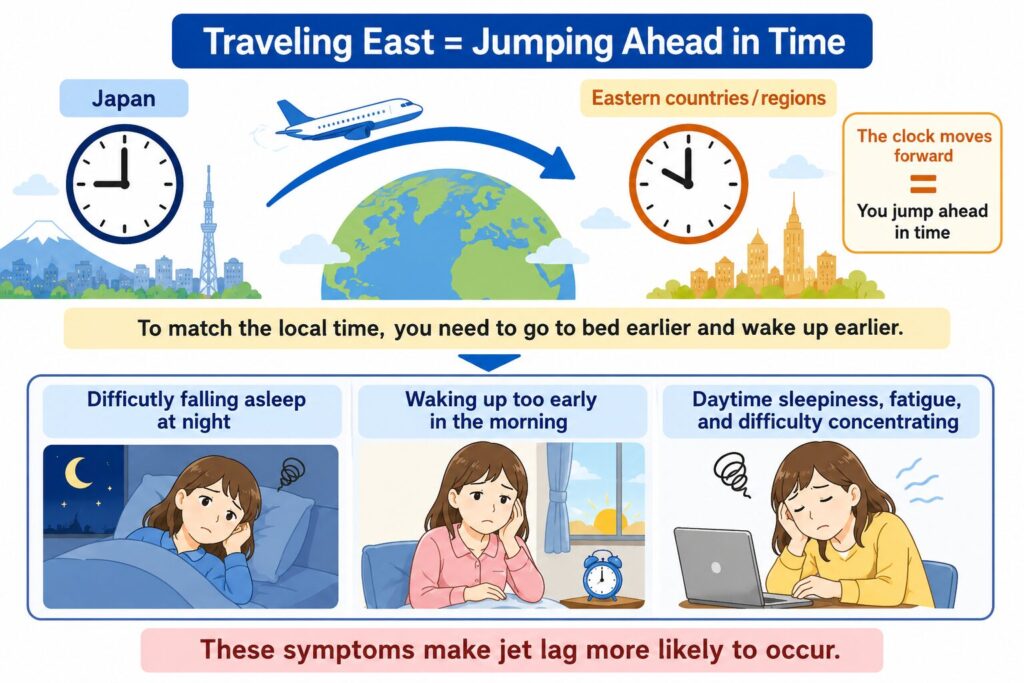
When you travel east, the local time is ahead of your departure point. In other words, it feels as though you have jumped forward in time.
To adjust to the new time zone, you need to go to bed earlier and wake up earlier than your body is used to.
Unfortunately, our biological clock does not adapt well to this type of change. As a result, you may experience symptoms such as:
- Difficulty falling asleep at night
- Waking up too early in the morning
- Daytime sleepiness, fatigue, and difficulty concentrating
These are the typical symptoms of jet lag.
Traveling West Means “Turning the Clock Back”
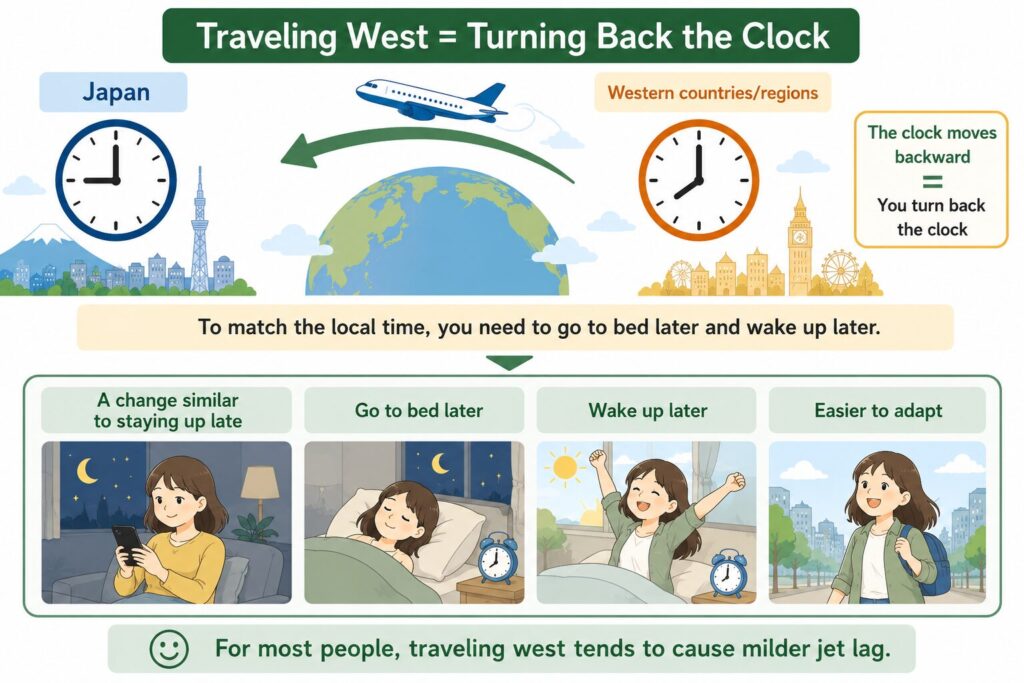
When you travel west, the local time is behind your departure point. It feels as though you have turned the clock back.
To adjust, you simply stay awake longer and go to bed later than usual.
This change is similar to staying up late, which is generally easier for the human body to adapt to because our internal clock naturally runs slightly longer than 24 hours.
For this reason, many people experience milder jet lag when traveling west.
Tips for Reducing Jet Lag
Although jet lag cannot be completely prevented, the following strategies may help reduce its effects:
- Start adjusting to your destination’s time zone as soon as you board the plane.
- After arrival, eat meals and sleep according to local time.
- Get morning sunlight to help reset your biological clock.
- Stay well hydrated and avoid excessive alcohol consumption.
Summary
Jet lag tends to be worse after traveling east because your body must shift to an earlier sleep and wake schedule, something that our biological clock finds difficult.
In contrast, traveling west usually requires going to bed and waking up later, a change that is more compatible with the natural rhythm of the human body.
Understanding how your biological clock works can help you manage jet lag more effectively and make your next international trip more enjoyable.