If You Are Told That Your Kidney Function Is Reduced
Have you ever felt worried after being told that your “kidney function is reduced” when receiving the results of a health checkup?
In routine health checkups, kidney function is generally assessed using blood test values such as Cr (creatinine) and eGFR (estimated glomerular filtration rate). Here, we will explain what these values mean and how to think about them when an abnormality is found.
1. What Is Creatinine?
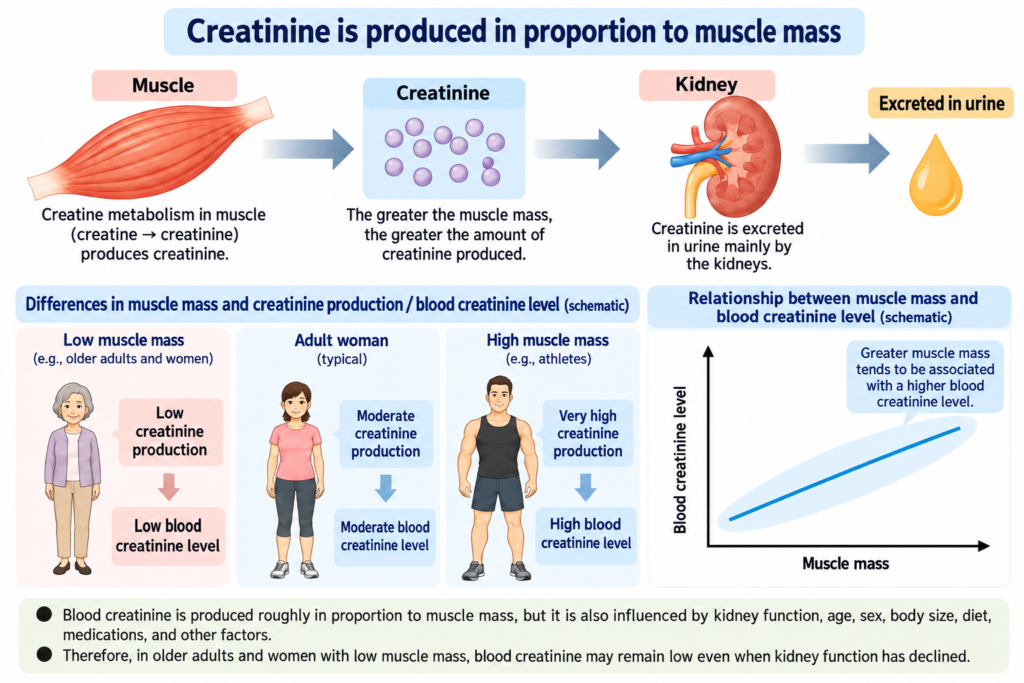
Creatinine is, in a sense, a waste product produced after muscles use energy.
Muscles require an energy source called ATP (adenosine triphosphate) to contract. When ATP is produced in muscle cells, a substance called creatine is involved in the process.
After being used, creatine is converted into creatinine, which is then eliminated from the body through the kidneys and excreted in the urine.
Under normal conditions, the amount of creatinine produced and the amount excreted remain relatively constant, so the concentration of creatinine in the blood also remains within a relatively stable range.
However, when kidney function declines, the kidneys become less able to eliminate creatinine. As a result, creatinine accumulates in the blood and its level rises. This is why creatinine is used as an indicator of kidney function.
2. The Relationship Between Creatinine and Muscle Mass
One important point to keep in mind is the effect of muscle mass.
People with greater muscle mass generally produce more creatinine. However, the kidneys’ ability to excrete creatinine does not increase in proportion to muscle mass. As a result, the blood creatinine concentration at which production and excretion are balanced may be higher in people with greater muscle mass than in those with less muscle mass.
Therefore, when creatinine is elevated, it can be difficult to determine from this value alone whether the level is high because kidney function is actually impaired, or simply because the person has a greater amount of muscle mass.
3. What Is eGFR (Estimated Glomerular Filtration Rate)?
From the explanation above, you may now understand why creatinine cannot always be evaluated simply: its baseline level is affected by muscle mass.
In general, older adults tend to have lower creatinine levels because muscle mass decreases with age. Men also tend to have higher creatinine levels than women because they generally have greater muscle mass.
For this reason, eGFR (estimated glomerular filtration rate) has come to be used as an indicator of kidney function that incorporates statistical adjustments for differences in muscle mass and other factors associated with age and sex.
The actual GFR (glomerular filtration rate) refers to the amount of fluid filtered by the kidneys per minute. A normal value is approximately 100 mL/min. The lower the GFR, the more reduced kidney function is considered to be.
However, accurately measuring GFR requires specialized testing. Therefore, in routine health checkups, eGFR, which is calculated using age, sex, and serum creatinine levels, is generally used instead.
It is important to remember, however, that eGFR is still only an estimate adjusted primarily for age and sex. Therefore, in muscular individuals, a higher creatinine level may result in a lower eGFR, making kidney function appear worse than it actually is.
Conversely, in someone who is very thin and has little muscle mass, eGFR may appear higher, making kidney function seem better than it actually is.
In this way, depending on body composition, even eGFR may not always provide an accurate assessment of kidney function.
4. Cystatin C
If creatinine and eGFR from a routine health checkup can sometimes be difficult to interpret because of the influence of muscle mass, what can be done?
One useful test that can complement these measurements is cystatin C.
Cystatin C is a protein produced at a relatively constant rate by cells throughout the body. With normal kidney function, it is almost completely filtered by the kidneys and then broken down.
An important point is that the production of cystatin C is not significantly affected by muscle mass.
Therefore, when there is a possibility that an elevated creatinine level may simply reflect greater muscle mass, measuring cystatin C can be one useful way to obtain a better assessment of actual kidney function.
However, cystatin C is not a perfect or foolproof test. It can also be affected to some extent by age and sex, as well as by factors such as inflammation, medications, and body fat. In some cases, additional, more detailed testing may be necessary.
Summary
Even if you are told that your creatinine is high or your eGFR is low during a health checkup, this does not necessarily mean that your kidney function is impaired.
In some cases, the results may be influenced by factors such as muscle mass.
One way to further investigate this is to measure cystatin C, which is less affected by muscle mass. However, this test is not perfect either.
The most important thing is not to make a judgment based solely on health checkup numbers and become unnecessarily worried.
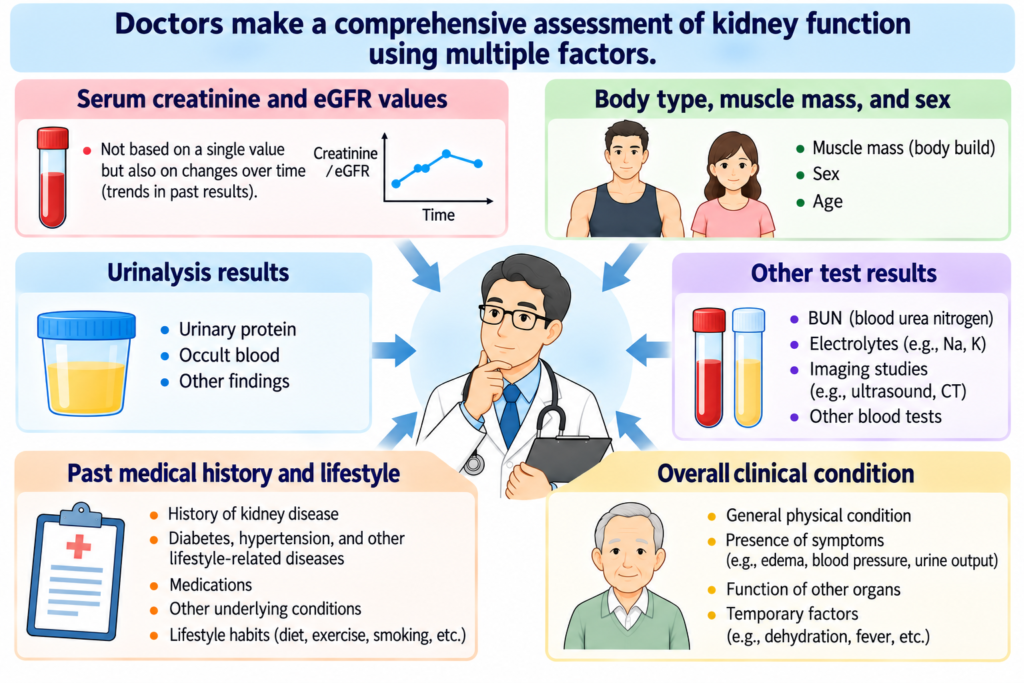
Doctors do not assess kidney function based on these numbers alone. They consider them together with factors such as body composition, changes in previous test results, other findings such as protein in the urine, and your medical history.
If you are told that there is an abnormality, do not simply ignore it. Instead, consult a healthcare professional at an early stage and have your doctor assess your overall condition so that you can better understand the actual state of your health.