Red, White, and Blue at the Barbershop — The Medical History Behind the Barber Pole
We have all seen the familiar barber pole, with its red, white, and blue stripes spinning outside a barbershop.
You may have heard that red represents arteries, blue represents veins, and white represents lymph.
It sounds surprisingly convincing, especially from a medical perspective. But historically, this explanation is not well established.
To understand the origins of the barber pole, we need to go back to the barber-surgeons of medieval Europe.
At the time, barbers did much more than provide grooming services. In addition to cutting hair and shaving, they performed procedures such as treating wounds, extracting teeth, and bloodletting, a practice in which blood was deliberately removed from the body as a form of treatment.
In other words, barbering and surgery were once closely connected.
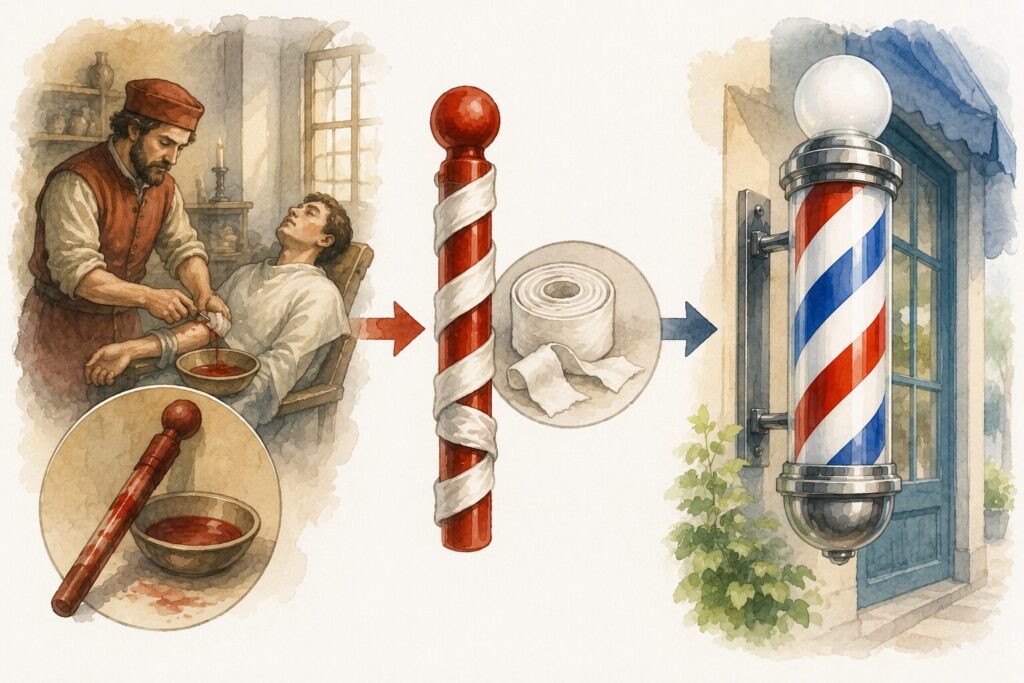
The original red and white colors of the barber pole are also widely believed to be associated with bloodletting.
During bloodletting, patients are said to have gripped a pole to make the veins in the arm more prominent. According to one theory, the pole was painted red so that bloodstains would be less noticeable. White bandages used during the procedure were wrapped around the pole or hung out to dry, possibly inspiring the familiar spiral pattern of white around red.
In this interpretation, red became associated with blood and the bloodletting pole, while white represented the bandages.
But where did the blue come from?
This is where the history of barbers and surgeons becomes particularly interesting.
In medieval and early modern Europe, barbers performed surgical procedures and sometimes belonged to the same professional organizations as surgeons. In England, the organizations representing barbers and surgeons were united in 1540 to form the Barber-Surgeons’ Company.
As medicine and surgery developed, however, the roles of barbers and surgeons gradually became more distinct. In 1745, the surgeons formally separated from the organization.
There are several theories about how blue became part of the barber pole. One links it to the historical separation of barbers and surgeons, while another suggests that red, white, and blue became popular in the United States because they matched the colors of the American flag. The exact origin of the blue stripe, however, remains uncertain.
So the familiar explanation:
Red = arteries
Blue = veins
White = lymph
is certainly easy to remember, but it is not supported as the original historical meaning of the barber pole.
The history instead points toward red being associated with blood and bloodletting, and white with bandages, while the origin of the blue stripe remains less clear.
The barber pole we casually pass on the street carries traces of a time when barbering and surgery were closely intertwined.
The next time you see those red, white, and blue stripes spinning outside a barbershop, you may find yourself looking at them a little differently.