
Living Will(4): What Should You Write in a Living Will? — A Practical Approach Without Overcomplicating Things
In the previous article, I discussed how creating a living will is not the final step. It is equally important to share your wishes with your family and healthcare professionals and to create an environment in which your preferences can be respected when the time comes. This process is known as ACP (Advance Care Planning).
So, when you actually sit down to write a living will, what should you include?
Many people feel overwhelmed at first, thinking, “Do I need to make detailed decisions about every possible medical treatment that might arise in the future?”
The answer is no.
In fact, there is no need to decide every detail in advance.
Even healthcare professionals cannot predict every situation that may occur in the future.
When creating a living will, what matters most is identifying the major principles that are truly important to you and avoiding the temptation to plan for every possible scenario. A flexible approach often works best.
In this article, I will focus on three practical points.
1. Focus on Two Key Medical Decisions: CPR and Artificial Nutrition
When difficult medical decisions arise, family members often find the following two areas to be the most challenging and emotionally burdensome. It is helpful to clarify your wishes regarding these topics first.
1) Cardiopulmonary Resuscitation (CPR)
If your heart or breathing stops, would you want attempts to restart them?
Consider whether you would want:
① Chest compressions (cardiac massage)
② Endotracheal intubation and subsequent management with a mechanical ventilator
Please refer to the CPR-related articles on this blog for more detailed information before making your decision.
2) Artificial Nutrition and Hydration
If you become unable to eat or drink by mouth, would you want artificial methods of providing nutrition and fluids?
Please refer to the nutrition management articles on this blog and consider your preferences regarding:
① Total parenteral nutrition (central venous nutrition)
② Tube feeding
a) Nasogastric tube feeding
b) Gastrostomy (feeding tube placed into the stomach)
③ Peripheral intravenous fluids
You may, of course, include preferences regarding other medical treatments as well. However, compared with decisions about CPR and artificial nutrition, these additional choices often place a smaller emotional burden on family members if they need to make decisions on your behalf.
For many people, clarifying these two areas is a sufficient starting point.
If possible, consider adding a brief note explaining why you feel that way. A short explanation can help family members better understand and accept your wishes when difficult decisions must be made.
2. Be Flexible About Where You Spend Your Final Days
Many living will templates include a section asking where you would like to spend the end of your life.
However, when that time comes, a person may already have lost the ability to make decisions or communicate their wishes. In addition, whether care can be provided in a particular location often depends on the circumstances of family caregivers and the availability of appropriate support services.
For that reason, it may be better not to be overly specific about the place of care.
Rather than making rigid demands, consider expressing preferences such as:
- “I would prefer to remain at home if possible.”
- “If feasible, I would like to stay in a familiar environment.”
You might also add a sentence such as:
“I hope those around me will choose the option that is most reasonable and sustainable given the circumstances at that time.”
This approach shows consideration for those who may ultimately be responsible for your care and reflects the realities of end-of-life decision-making.
3. Entrust Unpredictable Decisions to a Trusted Person
Medical conditions can change rapidly, making it impossible to anticipate every situation in advance.
That is why one of the most important statements you can include is:
“If decisions arise that are not specifically addressed in this document, I would like them to be entrusted to the judgment of __________, whom I trust.”
By identifying a trusted family member or other individual to help guide decisions on your behalf, you create a framework for handling unforeseen circumstances.
Just as importantly, you should share your values with that person beforehand:
- How do you want to live?
- What matters most to you?
- What kinds of outcomes would you find acceptable or unacceptable?
If those conversations have taken place, that person can approach difficult decisions by asking, “What would they have wanted?”
This is the essence of ACP (Advance Care Planning).
Sometimes the decision made may differ from what you might have imagined when you were healthy.
And that is okay.
After all, it would be a decision made by someone you trust—someone who carefully considered what you would have wanted under the circumstances.
A living will is not a rigid set of instructions designed to bind those around you.
Rather, it is a compass that helps guide people when they face uncertainty.
There is no need to strive for perfection.
Start by documenting the few things that matter most, and then entrust the rest to the people who know and care about you.
That may be the most practical and meaningful living will of all.
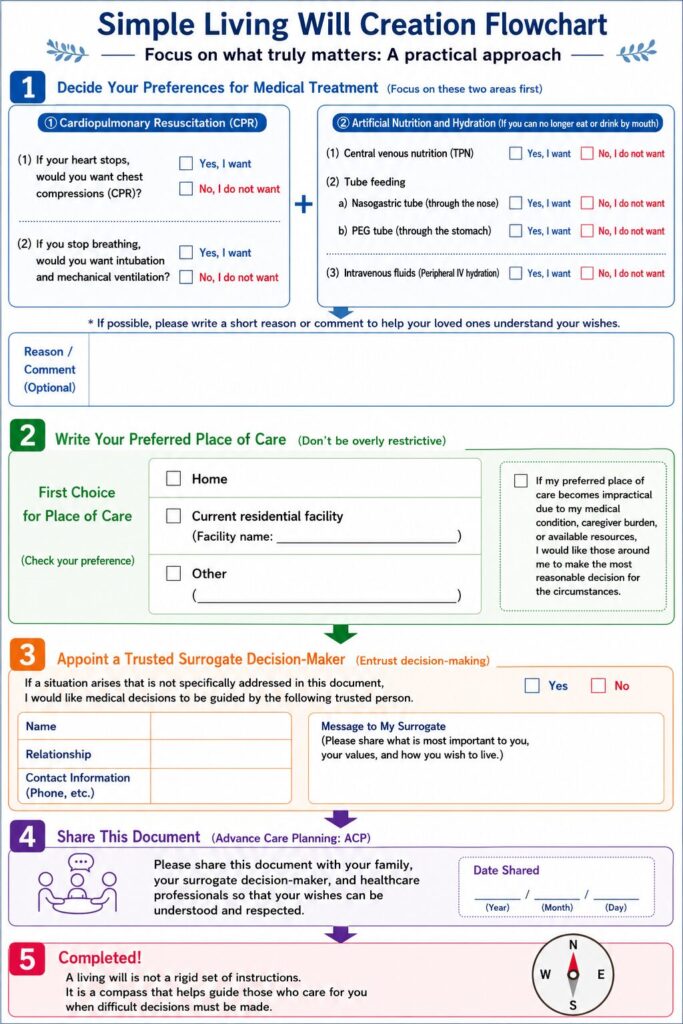
Once you have clarified your preferences using the flowchart above, consider using one of the Living Will templates published by various organizations to create your own document.
Below are a few examples of downloadable templates and resources.
You do not need to complete every section. Filling in only the parts you feel comfortable with is perfectly sufficient.
There is no required format for a living will, so you are free to create your own if you prefer.
Most importantly, be sure to share your wishes with your family members and other people close to you.
Living Will Templates (Examples)
There is no legally mandated format for a Living Will in Japan. Choose a template that you find easy to understand and use.
The following resources are published in Japanese.
Japan Society for Dying with Dignity
About the Living Will
Japan Society for Dying with Dignity: “What Is a Living Will?”
The society provides its own Living Will form (Declaration for a Dignified Death).
Matsumoto Medical Association
My Living Will (Advance Directive)
Matsumoto Medical Association: “My Living Will (PDF)”
An easy-to-print Advance Directive form in A4 format.