Even Without Symptoms, High Blood Pressure Should Not Be Ignored
If you are told during a health checkup that your blood pressure is high, is it really okay to leave it untreated as long as you have no symptoms?
This time, let’s take a look at why high blood pressure can be a problem.
First of all, what determines our blood pressure?
If we set aside the precise medical mechanisms for a moment and put it simply, we can think of it as:
Blood pressure = Fluid volume × Vascular resistance
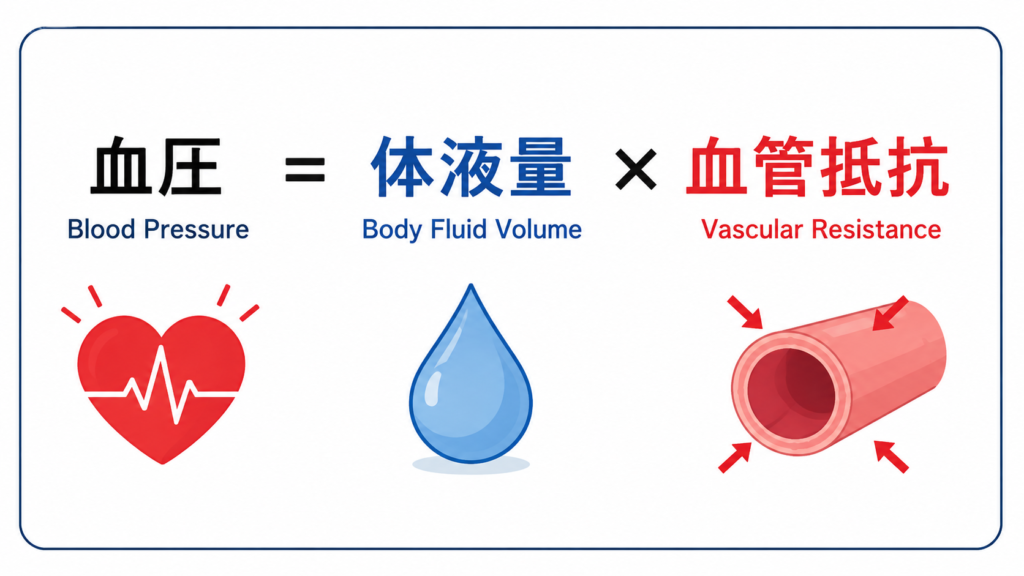
Therefore, broadly speaking, blood pressure-lowering medications can be divided into two major types:
- Diuretics, which reduce the amount of fluid in the body
- Medications that dilate blood vessels and reduce vascular resistance
1. Why Does Fluid Volume Increase?
One of the major causes is consuming too much salt.
Water moves together with Na (sodium).
Since salt is NaCl, consuming too much salt increases the amount of sodium(Na) in the body, and water is retained along with it.
As a result, the amount of fluid in the body increases, which can lead to higher blood pressure.
Of course, there are other causes of increased fluid volume besides excessive salt intake, but we will leave those out for now.
2. How Does Vascular Resistance Increase?
When blood vessels constrict, vascular resistance increases.
For example, when you are mentally tense or stressed, the sympathetic nervous system causes your blood vessels to constrict. This increases vascular resistance and raises blood pressure.
On the other hand, as atherosclerosis progresses, blood vessels become stiffer and lose their flexibility.
Normally, when blood flows through them, blood vessels expand to some extent in a flexible manner, helping to reduce fluctuations in blood pressure.
However, when blood vessels become stiff, they can no longer perform this function adequately, making blood pressure more likely to rise.
In other words, there are various reasons why blood pressure can increase. Therefore, when treating high blood pressure, it is important to consider why the blood pressure is elevated.
3. Why Is High Blood Pressure a Problem?
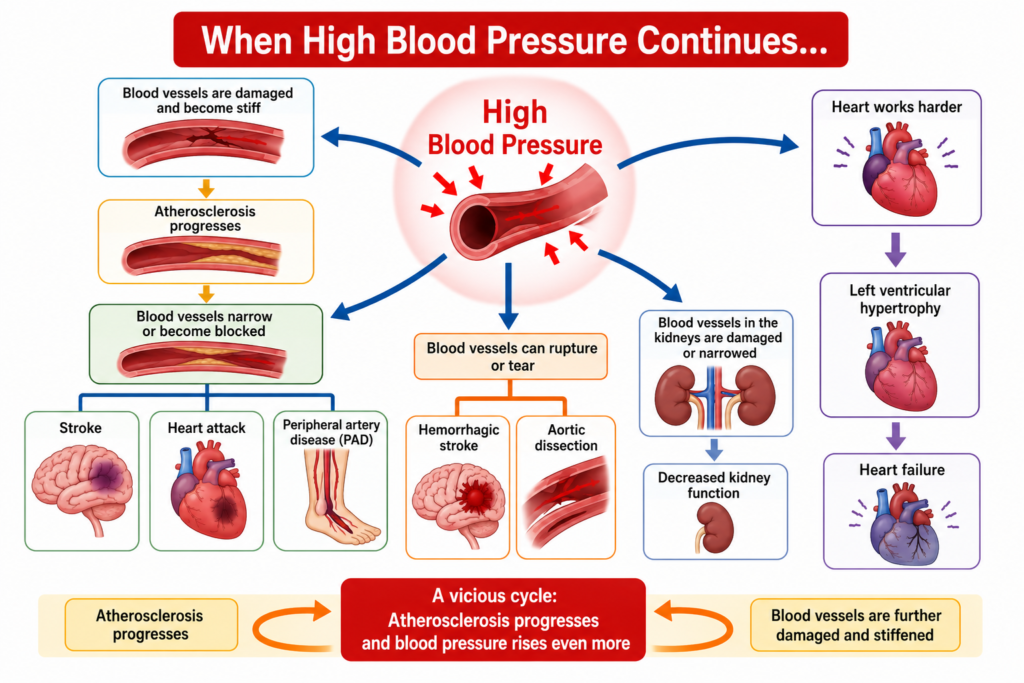
When blood pressure is high, greater force is exerted on the walls of the blood vessels, making them more susceptible to damage.
As a result, substances such as cholesterol are more likely to accumulate in the vessel walls, accelerating atherosclerosis.
As atherosclerosis progresses, blood vessels become stiffer, and the passageway inside the blood vessel, known as the lumen, may become narrower.
If blood vessels become narrowed or blocked, this can lead to conditions such as ischemic stroke, myocardial infarction, and peripheral arterial disease.
In addition, if the small blood vessels in the kidneys become damaged or narrowed, it may become more difficult for enough blood to reach the kidneys, potentially leading to decreased kidney function.
Furthermore, if the walls of blood vessels become damaged or weakened, they may rupture and cause conditions such as hemorrhagic stroke.
Another possibility is arterial dissection, in which a tear develops in the vessel wall and blood enters between the layers of the wall.
High blood pressure also places a significant burden on the heart.
The heart has to pump blood against the increased pressure in the blood vessels, requiring it to work harder.
If this condition continues for a long time, it can cause the heart muscle to become thicker, a condition known as cardiac hypertrophy, and may eventually lead to heart failure.
As explained above, high blood pressure and atherosclerosis can also affect each other.
High blood pressure damages the blood vessels
↓
Atherosclerosis progresses
↓
The blood vessels become stiffer, making blood pressure more likely to rise further
This can create a vicious cycle.
As you can see, leaving high blood pressure untreated may accelerate atherosclerosis, making blood pressure even higher and potentially causing damage to various organs, including the brain, heart, and kidneys.
4. What Blood Pressure Should You Aim For?
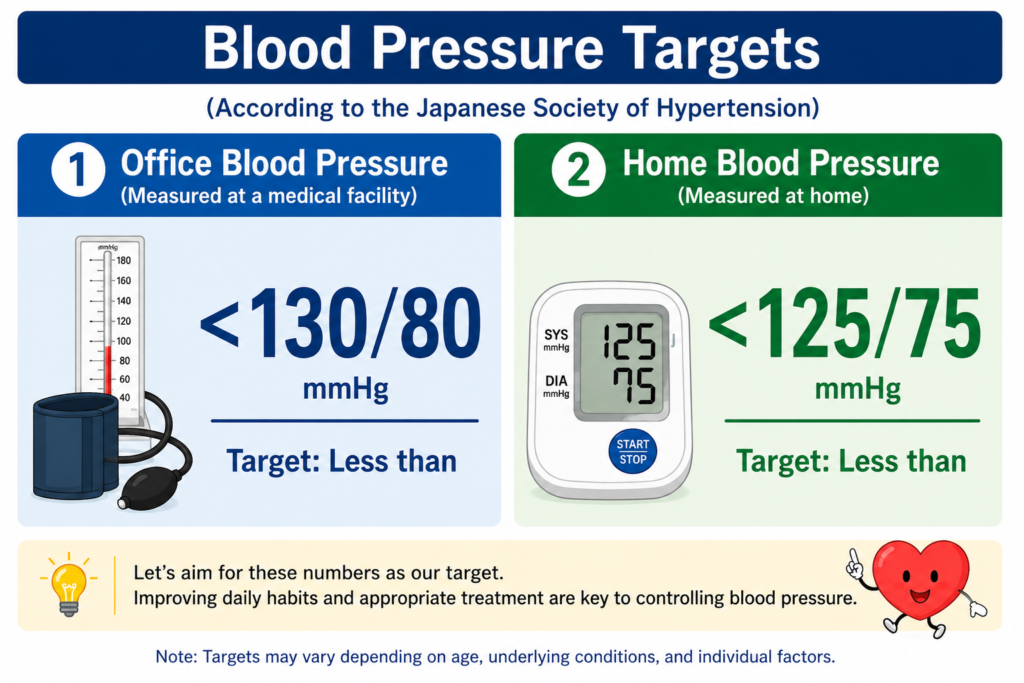
Based on various research findings, the Japanese Society of Hypertension currently recommends the following treatment targets:
- Office blood pressure: less than 130/80 mmHg
- Home blood pressure: less than 125/75 mmHg
The difference between these two targets takes into account the fact that blood pressure tends to be slightly higher in a medical setting because people may feel nervous during a doctor’s visit.
Therefore, these values can be considered useful targets.
However, exceeding these numbers does not necessarily mean that medication will be started immediately.
As mentioned in the article on our weight-loss program, studies have reported that blood pressure can improve when people with obesity lose approximately 5–10% of their current body weight.
Blood pressure may also improve through dietary changes, such as reducing salt intake.
Going to the hospital does not necessarily mean that you will immediately be prescribed medication.
So, if you are told that your blood pressure is high, don’t hesitate to see a doctor.
I hope this article has helped you understand, even just a little, the risks of leaving high blood pressure untreated—even when you have no symptoms.