
Have You Been Disinfecting That Wound? The Basics of “Moist Wound Healing” You Should Know
When you scrape your knee or make a small cut on your finger, do you still treat it by “applying disinfectant and covering it with gauze”?
In fact, the way we think about wound care has changed considerably in modern medicine.
What you may be doing with the best of intentions could actually delay healing or increase pain.
In this article, I will introduce a modern approach to wound care called “moist wound healing,” which aims to help wounds heal quickly and with as little scarring as possible.
1. What Happens Inside the Body When You Get a Wound?
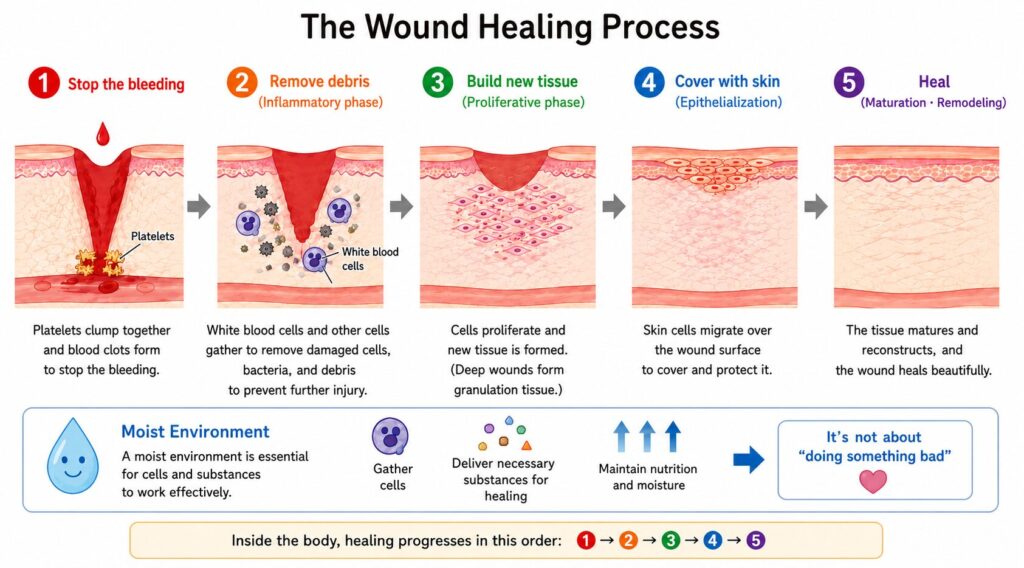
When an injury occurs, bleeding usually happens first.
To stop the bleeding, platelets gather at the site of the damaged blood vessel and help seal the wound.
Platelets work much like sandbags placed along a breached riverbank to prevent water from escaping the river.
Once the damaged blood vessel is sealed and bleeding has stopped, various processes involved in wound healing begin.
Cells such as white blood cells gather around the wound, removing damaged cells and dealing with invading bacteria and other microorganisms.
After that, the process of repairing the wound gets underway.
Small wounds can be repaired with tissue similar to the original tissue. However, when there is a larger tissue defect, fibrous tissue fills the gap instead of the original tissue being completely restored.
In this way, the wound gradually heals. During this process, various substances are released from the wound to attract white blood cells, which remove damaged cells and bacteria, as well as other cells involved in tissue repair.
These substances form the fluid that makes a wound look “oozy” or “weeping.”
Therefore, the fact that a wound is “weeping” is not necessarily a bad thing.
Furthermore, cells can die in a dry environment.
Therefore, keeping the wound moist is an important condition for preventing the cells needed for wound repair from dying.
If you cover a wound with gauze at this stage, the wound may become dry. Cells that are trying to repair the wound can then die, slowing the healing process.
In addition, bacteria can more easily multiply around dead cells, potentially leading to infection.
For this reason, it is important not to let the wound dry out.
In other words, inside a wound, a series of healing processes is taking place:
“Stopping the bleeding → Cleaning the wound → Creating new tissue → Covering the wound with skin”
This is how the body gradually heals a wound, with many different cells and substances working together.
The key point here is:
“Do as little as possible to interfere with the body’s natural healing process.”
2. Why Can Disinfection and Drying Actually Be Counterproductive?
Disinfectants can also kill normal cells
Disinfectants have powerful antibacterial effects, but they do not only attack bacteria. They can also damage and kill normal cells and cells that have gathered at the wound to promote healing, potentially delaying the healing process.
In other words, “disinfecting to kill bacteria” can actually “damage the cells that are trying to heal the wound.”
Therefore, for minor scrapes and cuts at home, the basic approach is not to disinfect the wound, but to thoroughly rinse it with tap water.
“Weeping” can be a sign of healing
When people see fluid coming from a wound, they may assume that the wound is “infected” or “full of bacteria.”
However, this fluid is called exudate, and as explained above, it contains substances that are necessary for wound repair.
The body produces this exudate as part of its effort to heal the wound.
Therefore, “a weeping wound does not necessarily mean that it is infected.”
Rather, it can mean that the wound has an environment that supports the healing process.
Of course, if a large amount of exudate is produced, pus appears, or redness, swelling, or pain becomes increasingly severe, infection or another problem may be present, so medical attention may be necessary.
Gauze can cause the wound to dry out
When gauze is placed over a wound, it absorbs moisture from the wound and can cause it to dry out.
A suitably moist environment is necessary for skin cells to migrate across the wound surface and cover the wound.
When a wound dries out, dead cells, blood, and other substances can harden and form a scab.
In other words, the formation of a scab can be a sign that the wound is not healing under ideal conditions.
Thus, the traditional idea that “wounds should be allowed to dry out” has gradually been replaced by the modern concept that “wounds heal more easily when an appropriately moist environment is maintained.”
This is the basic concept behind moist wound healing.
3. Proper Wound Care: Key Points of Moist Wound Healing
So, what should you do if you get injured?
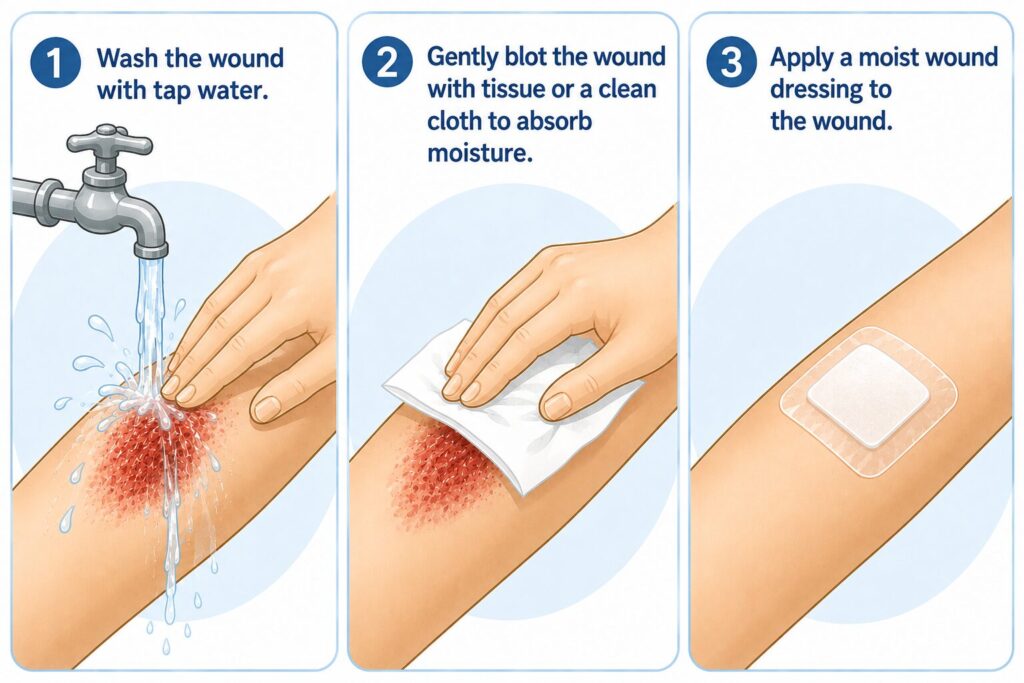
The key is to “wash, keep the wound from drying out, and cover it appropriately.”
① Wash the wound thoroughly with tap water
First, thoroughly rinse away any sand, dirt, or other contaminants from the wound using tap water.
If foreign material remains in the wound, it can become a cause of infection.
In general, the basic approach is to wash the wound thoroughly with tap water rather than disinfecting it. For minor wounds at home, there is usually no need to apply a disinfectant in the first place.
② Cover the wound appropriately to prevent it from drying out
To prevent a wound from drying out, cover it appropriately and maintain a moist environment.
A typical Band-Aid® is essentially an adhesive bandage with gauze, and it can cause the wound to dry out.
Hydrocolloid dressings, such as Kizu Power Pad®, are designed to absorb exudate from the wound while keeping the surface in contact with the wound moist, thereby preventing the wound from drying out.
Using an appropriate dressing in this way helps prevent the wound surface from drying out and maintains an environment that makes it easier for the skin to regenerate.
When a wound becomes dry, it can be quite painful. With moist wound healing, however, the nerves at the wound surface are protected and are no longer exposed to irritation caused by drying, so the pain can decrease surprisingly significantly.
※ Important points when using hydrocolloid dressings
Replace the dressing every few days, or whenever fluid leaks out or the dressing becomes detached. When replacing it, wash the wound again with tap water and check whether the area around the wound has become red or swollen or whether pus is present, as these may be signs of infection.
However, the same approach is not suitable for every wound. If the wound is deep or infection is suspected, do not attempt moist wound healing on your own. Instead, seek medical attention.
4. When Should You See a Doctor?
Home treatment is generally appropriate only for minor wounds.
If any of the following apply, do not rely on self-treatment; consult a doctor.
- The wound is deep or widely open
- You cannot remove sand, dirt, or other foreign material
- The bleeding does not stop
- A foreign object remains inside the wound
- You have difficulty moving the injured area or experience numbness
- Pain or swelling becomes worse after several days
- The area around the wound becomes red, swollen, or warm
- Pus comes out of the wound
- You have been bitten by an animal or otherwise suffered an animal bite
- The wound is on an area such as the face where scarring is a concern
In these situations, it is important not to treat the injury as a simple scrape or minor cut.
Summary: “Wash and Cover”
The key message of modern wound care is “moving beyond disinfectants and gauze.”
Treating a wound does not simply mean disinfecting it and covering it with gauze.
First, wash the wound thoroughly with tap water, then cover it appropriately and maintain a moist environment. This allows the body’s natural ability to heal the wound to work more effectively.
During the healing process, an inflammatory response occurs, white blood cells and other cells become active, exudate is produced, skin cells cover the wound, and new tissue is formed.
Moist wound healing is a treatment approach that takes advantage of the body’s natural healing mechanisms and helps them work as effectively as possible.
The next time you get a minor injury, remember that there is an alternative to the traditional approach of “disinfect and cover with gauze”: “wash and cover.”
【Traditional Wound Care vs. Moist Wound Healing】
| Comparison | Traditional treatment (disinfectant + gauze) | Moist wound healing (current approach) |
|---|---|---|
| Initial treatment | Apply a disinfectant | Thoroughly wash with tap water (do not disinfect) |
| What covers the wound | Gauze or an ordinary adhesive bandage | Hydrocolloid dressing or other appropriate wound dressing |
| Wound environment | Allow it to dry (form a scab) | Keep it moist (do not allow it to dry out) |
| Pain | More likely to hurt because of drying | Less painful because the nerves are protected |
| Healing | More likely to leave a scar and may heal more slowly | More likely to heal quickly and with less noticeable scarring |
※ This article provides general information about wound care. If you are concerned about a wound or have severe symptoms, be sure to seek medical attention.